RCSB PDB New Structures Screensaver
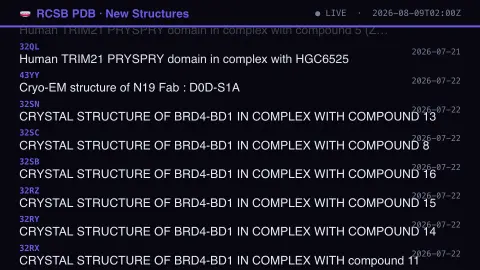
The RCSB PDB New Structures screensaver streams real newly-deposited protein and macromolecular structures as they're reported. It is free, runs in your browser, and ESC exits.
Live preview
Press ESC to leave fullscreen. Settings are saved in your browser only.
How the RCSB PDB New Structures screensaver works
The background pipeline polls the RCSB Protein Data Bank's own search and data APIs — the world's central archive of solved protein structures — every few minutes for new records.
Each new item eases up into its slot at the bottom of the list as it arrives.
A header shows a live/connecting indicator and the last update time.
No key is required for this key-less public endpoint.
Inside the Protein Data Bank
The Protein Data Bank is the shared archive of three-dimensional structures of proteins, DNA and RNA. It is maintained by the worldwide PDB (wwPDB) partnership, in which RCSB PDB is the US data center, PDBe the European partner and PDBj the Japanese partner. Authors deposit structures through the wwPDB deposition system, and annotators then process each entry, standardising names, checking ligands and generating validation reports.
Entries record structures determined by methods such as X-ray crystallography, solution or solid-state NMR, and electron microscopy. A PDB ID is assigned once the author completes the minimal deposition information and confirms the deposit. Before release, the author can still update coordinates, experimental data and header information, and unreleased data goes only to the entry’s authors.
Deposit and release are different moments. Releases happen weekly, on Wednesdays, and authors can ask for an entry to be held until publication or for a fixed period; a hold cannot run beyond one year from deposition. What you see is a description of an experiment, not a finding about disease or drugs, and an entry’s existence says nothing about whether a related paper has been published or confirmed.
A worked example
A real recent item scrolls into view with its details, then eases upward as newer ones arrive behind it.
Settings & tips
- Each entry is a real structure, deposited by a research lab worldwide.
- Accent recolours the header and highlights.
- The PDB has archived structures since 1971.
Frequently asked questions
- Is this real data?
- Yes — it's read live from the RCSB Protein Data Bank's own search and data APIs, the world's central archive of solved protein structures.
- Is a key needed?
- No. This is a fully key-less public API.
- How often does it refresh?
- The pipeline polls for new records every few minutes.
- Is it free?
- Yes — free, no download, in your browser.
- What is the difference between deposit date and release date?
- Deposit is when authors submit the structure; release is when it becomes public. Releases are weekly, and a held entry can wait until publication or up to one year from deposition.
- How are structures actually determined?
- By methods such as X-ray crystallography, NMR and electron microscopy. Each produces a model of where atoms sit, with its own limits on precision, which is why entries include validation reports.
- Who runs the Protein Data Bank?
- The worldwide PDB (wwPDB) partnership maintains the single public archive. RCSB PDB is the US data center, with PDBe in Europe and PDBj in Japan among the partners.