NIH New Grants Screensaver
The NIH New Grants screensaver streams real NIH-funded research project grants as they're reported. It is free, runs in your browser, and ESC exits.
Live preview
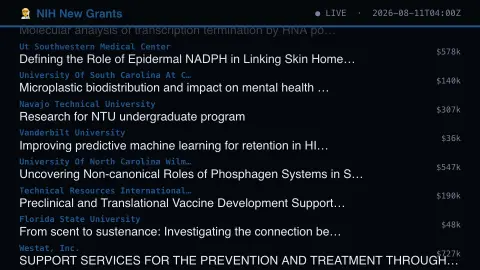
Press ESC to leave fullscreen. Settings are saved in your browser only.
How the NIH New Grants screensaver works
The background pipeline polls NIH RePORTER's own public API — the US National Institutes of Health's grant database — every few minutes for new records.
Each new item eases up into its slot at the bottom of the list as it arrives.
A header shows a live/connecting indicator and the last update time.
No key is required for this key-less public endpoint.
How NIH RePORTER describes grants
The National Institutes of Health is the US federal agency for biomedical research. It is made up of 27 institutes and centers, each focused on an area such as cancer, mental health, ageing or infectious disease, and roughly 80 to 85 percent of its budget goes to extramural research carried out at organisations outside NIH. RePORTER, short for Research Portfolio Online Reporting Tools, is the public search tool for those funded projects, and the saver reads its API.
A project in RePORTER is a funded grant, not a finished piece of research. NIH awards usually have a project period of several years, divided into budget periods of about twelve months, and each later year normally needs a progress report before the next funds are released. That is why the same project can appear again in a later fiscal year, and why a record dated now may describe work that has barely started.
RePORTER also covers projects funded by other health agencies, and its data is refreshed weekly. A listing shows who is funded for what, but not results or whether an approach worked, so the stream is a view of what was funded rather than what mattered most.
A worked example
A real recent item scrolls into view with its details, then eases upward as newer ones arrive behind it.
Settings & tips
- Each grant shows a real title, institution and award amount.
- Accent recolours the header and highlights.
- NIH is the largest public funder of biomedical research.
Frequently asked questions
- Is this real data?
- Yes — it's read live from NIH RePORTER's own public API, the US National Institutes of Health's grant database.
- Is a key needed?
- No. This is a fully key-less public API.
- How often does it refresh?
- The pipeline polls for new records every few minutes.
- Is it free?
- Yes — free, no download, in your browser.
- Does a grant mean the research succeeded?
- No. It means the project was approved and funded. Results appear later, if at all, in publications.
- Why can one project appear more than once?
- NIH usually commits money one budget period (about a year) at a time within a multi-year project, so a continuing project can show up again in each fiscal year.
- Where does NIH grant money go?
- NIH says its institutes and centers award roughly 80 to 85 percent of the budget to extramural research, meaning work done by organisations outside NIH itself.