Who Finishes Primary School Screensaver
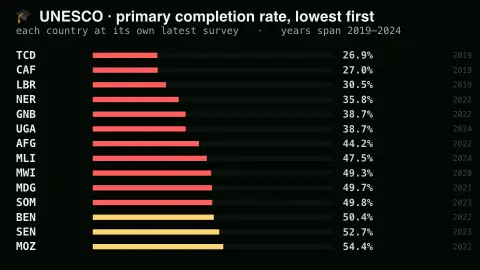
The Who Finishes Primary School screensaver shows uNESCO Institute for Statistics completion rates, key-less. Regional aggregates arrive mixed in with countries under the same field and are filtered out, and each country is shown at its own latest survey year rather than a single implied date. It's free, runs in your browser, and ESC exits.
Live preview
Press ESC to leave fullscreen. Settings are saved in your browser only.
How the Who Finishes Primary School screensaver works
The saver reads the source described above and draws it on a canvas — no account, no tracking.
UNESCO Institute for Statistics completion rates, key-less. Regional aggregates arrive mixed in with countries under the same field and are filtered out, and each country is shown at its own latest survey year rather than a single implied date.
It refreshes on a schedule, so what you see stays current.
Colours and any options can be changed in settings; nothing is stored beyond your own browser.
What a completion rate counts
The UNESCO Institute for Statistics (UIS), based in Montreal, describes itself as the official and trusted source of internationally comparable education data. Its completion rate, the basis of SDG indicator 4.1.2, is the share of a cohort of young people aged three to five years above the intended age for the last grade of a level who have completed that grade. For primary school with entry at age 6 and six grades, the intended age for the last grade is 11, so the reference group is 14 to 16. The offset allows for late entry and repetition.
The UIS metadata says the indicator draws on population censuses and household surveys, usually broken down by sex, location and household wealth. That is why each country appears at the date of its own most recent survey, so one country’s year may be several years from another’s. Aggregates for regions and income groups are published under the same field names as countries, so the saver filters them out to avoid ranking a continent beside a country.
Completion measures finishing the last grade, not what children learned: a child can complete primary school without reaching basic reading proficiency. A low rate can reflect late entry, dropout, repetition or late completion, and rates vary within a country by wealth, gender and place.
A worked example
UNESCO Institute for Statistics completion rates, key-less. Regional aggregates arrive mixed in with countries under the same field and are filtered out, and each country is shown at its own latest survey year rather than a single implied date.
Settings & tips
- Accent and Background recolour the display.
- Every value on screen comes from the live source — nothing is simulated.
- Press ESC to leave fullscreen.
Frequently asked questions
- Is this real data?
- Yes — it comes from the source named on this page and is refreshed on a schedule.
- Is a key needed?
- No. This source is fully key-less.
- Is it free?
- Yes, and it runs entirely in your browser.
- Why are the survey years different?
- The data come from censuses and household surveys that are run at different times in each country, so the most recent year varies. Showing each at its own year avoids implying a single date.
- Does completion mean children learned to read?
- No. It records finishing the last grade, and other indicators are needed to know whether students reached expected reading and maths levels.
- Why is the age group older than primary school age?
- The rate counts young people three to five years above the intended age for the last grade, which allows for late entry and repetition before they are counted as non-completers.