Powers of Ten Zoom Screensaver
This free screensaver zooms continuously through 25 real objects, from the observable universe (about 8.8 × 10²⁶ m across) down to the upper limit on the size of a quark (under 10⁻¹⁹ m), drawing each at its true size relative to the others. Press ESC to leave fullscreen.
Live preview
Press ESC to leave fullscreen. Settings are saved in your browser only.
How the Powers of Ten Zoom screensaver works
The dotted circle in the middle is always exactly 10^L metres across, where L falls steadily as you zoom in. An object d metres wide is drawn d ÷ 10^L of that circle wide, so one decade of zoom is a factor of ten on screen. That is a logarithmic zoom: the same screen distance covers the gap from a galaxy cluster to a galaxy as from a cell to a virus.
There are 25 objects in the table, each with a size taken from a named reference: NASA planetary fact sheets for the Sun, Jupiter, Earth, the Moon and Neptune's orbit; the IAU definition of the astronomical unit; NIST CODATA 2022 for the Bohr radius and the proton's charge radius; and Wikipedia articles citing the primary papers for the cosmological, biological and nuclear figures. The source of whichever object is on screen appears under its label.
The ruler at the bottom picks a round length (1, 2 or 5 times a power of ten) in a human unit, such as 5,000 km, 10 AU, 1 light-year or 50 nm, and draws it at the current scale, so you can read the width of the view directly.
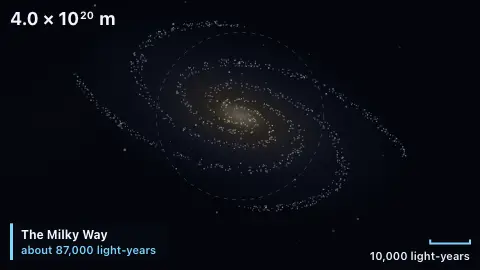
The movement slows near each object so its label can be read, then speeds up through the empty gaps. Objects are centred on the view (a few are shifted sideways so neighbours do not overlap); this is a ladder of sizes, not a map of where things are. The pictures are schematic icons, not photographs, and anything inside them, such as continents, spiral arms or quark dots, is illustrative and not to scale.
Where the sizes come from
The Sun (695,700 km), Jupiter (69,911 km), Earth (6,371 km), the Moon (1,737.4 km) and Neptune's orbit (semi-major axis 30.07 AU, 4,514.953 million km) are volumetric mean radii and orbital elements from the NASA NSSDC planetary fact sheets. The astronomical unit is exactly 149,597,870,700 m (IAU 2012) and the light-year is exactly 9,460,730,472,580,800 m (IAU). Voyager 1 crossed the heliopause at about 122 AU on 25 August 2012, per NASA's Voyager Interstellar Mission page.
The observable universe (about 8.8 × 10²⁶ m), the Laniakea Supercluster (about 404 million light-years), the Local Group (about 16.7 million light-years), the Andromeda Galaxy (152,000 light-years, D25), the Milky Way (87,400 ± 3,600 light-years) and the Oort cloud are taken from their Wikipedia articles, which cite the underlying papers; supercluster and galaxy edges depend on how they are defined. Mount Everest's height is the 2020 Nepal–China survey figure, the blue whale length is from the longest reliably measured specimen, and U.S. adult heights are from the CDC NCHS body-measurements page.
The small scales use a human hair's diameter of 17–180 µm, a red blood cell's 6.2–8.2 µm, E. coli at about 2 µm, a SARS-CoV-2 core of 91 ± 11 nm (cryo-EM, Adamczyk et al. 2021), DNA about 2 nm wide, the Bohr radius from NIST CODATA 2022, the uranium nucleus at about 11.7 fm (Angeli & Marinova 2013), the proton's CODATA 2022 charge radius of 0.84075 ± 0.00064 fm, and the quark size limit. Those figures were read from the cited pages, not measured here, and different methods give somewhat different values.
A worked example
Earth's volumetric mean diameter is 12,742 km (twice NASA's 6,371 km mean radius) and the Sun's is 1,391,400 km (twice 695,700 km), so about 109 Earths fit across the Sun. At the other end of the zoom, the hydrogen atom's Bohr radius is 5.29177 × 10⁻¹¹ m (CODATA 2022) and the proton's root-mean-square charge radius is 0.84075 × 10⁻¹⁵ m, so the atom's characteristic size is about 63,000 times the proton's. From the observable universe (about 8.8 × 10²⁶ m) down to the 10⁻¹⁹ m quark limit the zoom spans about 46 powers of ten.
Settings & tips
- Direction chooses zooming in, zooming out, or in-then-out.
- Speed scales how fast the zoom runs. The zoom always slows near each object.
- Show scale ruler toggles the bar that shows the current width of the view in a human unit.
- Background and Accent recolour the sky and the highlights.
- Press ESC to leave fullscreen.
Frequently asked questions
- Are the sizes real?
- Each size comes from a named reference (NASA fact sheets, the IAU, NIST CODATA 2022, or Wikipedia articles citing the primary papers) and the reference appears on screen with the object. Where the value is an estimate or a range, the label says so, for example 'about', a range, or 'upper limit'.
- Why does the observable universe say 'about 8.8 × 10²⁶ m'?
- It is a present-day (comoving) distance of about 93 billion light-years across, derived from a comoving radius near 46.5 billion light-years. Light has had only about 13.8 billion years to travel, but space has expanded in the meantime.
- Is the Oort cloud real?
- It is a hypothesis. It has never been directly observed and is inferred from the orbits of long-period comets, so the saver labels it hypothetical and gives the outer radius as about 75,000 AU with an uncertainty of 25,000 AU.
- How big is a quark?
- No size has been measured. Experiments show no internal structure larger than about 10⁻⁴ of a proton, below 10⁻¹⁹ m, so quarks behave as points. The last ring on the zoom marks that limit, not a measured size.
- Why are the pictures so simple?
- They are schematic icons drawn at the correct relative size. The continents, spiral arms, flagella and quark dots are illustrative and are not to scale internally.
- Why are some objects off to one side?
- Objects are centred on the view, but a few neighbours (the Moon beside Earth, Jupiter beside the Sun, the Milky Way beside Andromeda, E. coli beside a red blood cell) are shifted so they do not sit on top of each other. Position carries no meaning; only size does.
- Is this the film Powers of Ten?
- No. It is inspired by the idea of zooming by factors of ten, but it is a different, original animation with its own list of objects and sources.
- Does it need an internet connection or an account?
- No. The sizes are stored in the saver itself, there is no data feed, and it is free to run in the browser.