The Moon Tonight Screensaver
The Moon Tonight screensaver shows the Moon at its real phase for the current date, with the libration that makes it appear to nod and rock over a month. It runs in the browser with nothing to install; press ESC to exit.
Live preview
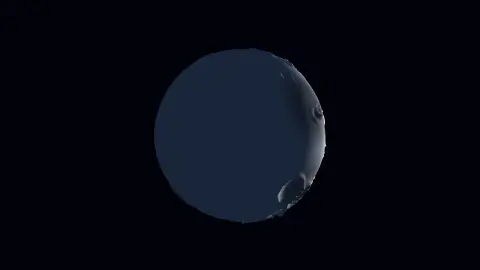
Press ESC to leave fullscreen. Settings are saved in your browser only.
How the The Moon Tonight screensaver works
The saver renders with three.js on your GPU. The library is vendored into this site rather than fetched from a CDN, and loads only when a 3D screensaver actually runs.
It reads nothing external — phase and libration are computed in the browser from the date.
The scene resizes with the window and releases its WebGL context when the saver stops, so shuffle mode and Multi-view can cycle 3D savers without exhausting the browser's context limit.
If WebGL is unavailable the saver says so on screen rather than showing an empty black box.
Why the Moon's face is not fixed
The Moon is tidally locked to the Earth: it rotates once per orbit, so the same hemisphere always faces us. Yet over time we can see about 59 per cent of its surface, according to NASA. The difference comes from libration, the slow apparent rocking of the Moon's face.
There are several kinds. Libration in longitude arises because the Moon's orbit is elliptical, so its orbital speed varies while its spin stays steady, and the face seems to swing east and west. Libration in latitude comes from the tilt of the Moon's spin axis relative to its orbit, which lets us peek over the north and south poles in turn. A smaller diurnal libration comes from the observer's changing position as the Earth rotates.
Phase is a separate matter. It depends only on the angle between the Sun, Moon and Earth, which sets how much of the near side is lit. Simple approximations can compute it from the date, which is accurate enough for display though not for precise ephemeris work. The interval between successive new moons averages about 29.5 days.
A worked example
Phase comes from the days elapsed since a known new moon against the 29.53-day synodic month, and drives the light direction. Libration is the subtler part: the orbit is elliptical and inclined, so the Moon appears to rock in longitude on a 27.55-day cycle and nod in latitude on a 27.21-day one. Over a full month those two together reveal about 59 per cent of the surface rather than the 50 per cent that tidal locking suggests.
Settings & tips
- Accent and Background recolour the scene; Speed changes the pace of the motion and the camera.
- Add it to a Multi-view grid, though 3D savers are heavier than 2D ones and a few per screen is plenty.
- Press ESC at any time to leave fullscreen.
Frequently asked questions
- What is libration?
- The apparent rocking of the Moon. It keeps one face toward us on average, but because it moves at varying speed along an elliptical orbit while rotating at a constant rate, we see slightly around each limb in turn.
- Is the surface a real map?
- No — the relief is generated with layered noise so the terminator has genuine texture to catch the light. The phase and libration are computed properly; the craters are not a lunar map.
- Does this need a special browser or plugin?
- No. It uses WebGL, which every current desktop and mobile browser supports. Nothing is installed and no plugin is required.
- Does it cost anything or need an account?
- No. Every screensaver here is free, runs in the browser and needs no sign-up.
- Is the far side of the Moon permanently dark?
- No. The far side gets sunlight just as the near side does. It is only permanently hidden from Earth, not from the Sun.
- How long is a lunar cycle?
- The interval from one new moon to the next averages about 29.5 days. That is a little longer than the Moon's orbit relative to the stars because the Earth also moves around the Sun.
- Why does the Moon look different at the horizon?
- The apparent size change near the horizon is an illusion of perception, not physics. The Moon's real angular size barely changes.