The Auroral Oval Screensaver
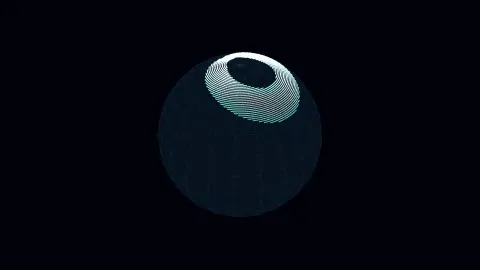
The Auroral Oval screensaver wraps NOAA's live OVATION aurora forecast onto a globe at the altitude the aurora actually occurs — about 100 kilometres up. It runs in the browser with nothing to install; press ESC to exit.
Live preview
Press ESC to leave fullscreen. Settings are saved in your browser only.
How the The Auroral Oval screensaver works
The saver renders with three.js on your GPU. The library is vendored into this site rather than fetched from a CDN, and loads only when a 3D screensaver actually runs.
It reads NOAA Space Weather Prediction Center's OVATION model output, which is public and needs no key.
The scene resizes with the window and releases its WebGL context when the saver stops, so shuffle mode and Multi-view can cycle 3D savers without exhausting the browser's context limit.
If WebGL is unavailable the saver says so on screen rather than showing an empty black box.
What the OVATION model forecasts
OVATION, short for Oval Variation, Assessment, Tracking, Intensity, and Online Nowcasting, is an empirical aurora model developed by Patrick Newell and colleagues at the Johns Hopkins University Applied Physics Laboratory and run operationally by NOAA’s Space Weather Prediction Center. It estimates electron and proton precipitation into the upper atmosphere at each latitude and longitude, driven by the solar wind speed and magnetic field measured at the L1 point, about 1.6 million kilometres upstream of Earth. The output is a grid of aurora intensity.
Aurora forms when charged particles guided by the geomagnetic field collide with atoms and molecules in the upper atmosphere, which then glow. The auroral oval is the ring of strongest activity around each magnetic pole, centred on the geomagnetic pole rather than the geographic one, which is why the ring appears off-centre on a map. It expands toward the equator during geomagnetic storms.
The forecast is a short-range nowcast: SWPC describes a lead time of roughly 30 to 90 minutes, the time solar wind takes to travel from L1 to Earth, not a whole night. When the upstream data is unavailable, the model falls back on the current Kp index. The values describe where and how strong aurora is likely, not a guarantee of a visible display; clear, dark skies and your exact position matter, as does moonlight.
A worked example
The model publishes an aurora probability for every degree of latitude and longitude — roughly a megabyte of grid — and cells below a threshold are dropped, or the globe vanishes under a haze. What remains is the oval: not a cap over the pole but a ring offset from it, because it follows the geomagnetic field rather than the geographic axis. Colour runs from green to red with intensity, and the camera nods between the poles.
Settings & tips
- Accent and Background recolour the scene; Speed changes the pace of the motion and the camera.
- Add it to a Multi-view grid, though 3D savers are heavier than 2D ones and a few per screen is plenty.
- Press ESC at any time to leave fullscreen.
Frequently asked questions
- Why is the oval a ring rather than a cap?
- Because it marks where field lines that stretch far out into the magnetotail return to the atmosphere. Those lines come down in a ring around the magnetic pole, so the aurora does too — and the magnetic pole is not the geographic one.
- Does this mean I can see it tonight?
- Only loosely. The model gives probability of aurora overhead, and seeing it also needs darkness, clear sky and no moon. It is a forecast of the phenomenon, not of your view of it.
- Does this need a special browser or plugin?
- No. It uses WebGL, which every current desktop and mobile browser supports. Nothing is installed and no plugin is required.
- Does it cost anything or need an account?
- No. Every screensaver here is free, runs in the browser and needs no sign-up.
- Why is the oval centred away from the geographic pole?
- The aurora follows the geomagnetic field, whose poles are offset from the rotation axis, so the oval is centred on the magnetic pole.
- What drives a bigger oval?
- Stronger coupling between the solar wind and Earth’s magnetic field, as during geomagnetic storms, pushes the oval toward lower latitudes.
- How far ahead is the forecast?
- NOAA describes the OVATION product as a 30-minute forecast, with a lead time of roughly 30 to 90 minutes based on solar wind measured at L1.