Other Solar Systems Screensaver
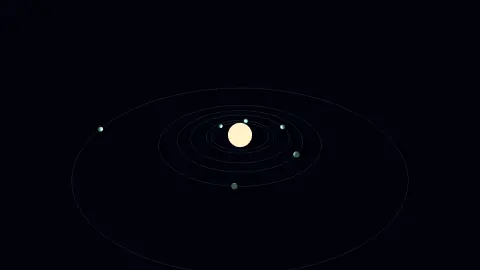
The Other Solar Systems screensaver draws real exoplanet systems to scale — TRAPPIST-1, Kepler-11, TOI-178 and HR 8799 — cycling through them with our own for comparison. It runs in the browser with nothing to install; press ESC to exit.
Live preview
Press ESC to leave fullscreen. Settings are saved in your browser only.
How the Other Solar Systems screensaver works
The saver renders with three.js on your GPU. The library is vendored into this site rather than fetched from a CDN, and loads only when a 3D screensaver actually runs.
It reads measured values from the discovery literature, held in the saver because the NASA Exoplanet Archive sends no CORS headers a browser can use.
The scene resizes with the window and releases its WebGL context when the saver stops, so shuffle mode and Multi-view can cycle 3D savers without exhausting the browser's context limit.
If WebGL is unavailable the saver says so on screen rather than showing an empty black box.
How planets around other stars are found
The first planet found orbiting a Sun-like star, 51 Pegasi b, was announced in 1995 by Michel Mayor and Didier Queloz, and confirmed exoplanets now number in the thousands. Almost none are seen directly. Most are found by indirect signals, chiefly the transit method, which detects the tiny dip in a star’s brightness when a planet crosses its face, and the radial-velocity method, which detects the wobble a planet’s gravity causes in the star’s motion.
Each method reveals different properties. A transit gives the planet’s size relative to its star and the orbital period, while the wobble gives a minimum mass. Combining both gives density, a clue to whether a world is rocky or gaseous. Direct imaging works only for young, massive planets far from their star, as with the four planets of HR 8799. Orbital periods follow from Kepler’s third law: the smaller the orbit, the shorter the year, and some planets close to their star orbit in less than a day.
The properties used in the scene are measured values from the discovery literature, held in the saver and not fetched live. Measurements carry uncertainty, often considerable, and a system such as TRAPPIST-1, with its seven Earth-sized planets, is known from a combination of transits and orbital timing, so details of individual worlds can be revised.
A worked example
Each system is scaled so its outermost planet reaches the same radius, which makes the comparison between systems immediate. TRAPPIST-1's seven planets all orbit closer than Mercury does to the Sun — the entire system would fit inside the empty space at the centre of ours. HR 8799 is the opposite extreme: four giants at 16 to 68 AU, imaged directly rather than inferred.
Settings & tips
- Accent and Background recolour the scene; Speed changes the pace of the motion and the camera.
- Add it to a Multi-view grid, though 3D savers are heavier than 2D ones and a few per screen is plenty.
- Press ESC at any time to leave fullscreen.
Frequently asked questions
- Why is the data not live?
- Because the NASA Exoplanet Archive does not send the CORS headers a browser needs, so a page cannot read it directly. Rather than invent plausible numbers, this ships a fixed set of real measured ones and says so.
- Are the planet sizes to scale too?
- No, and only the distances are. Planet radii are compressed logarithmically, because a gas giant is eleven times Earth's radius and drawn honestly would hide everything else in the system.
- Does this need a special browser or plugin?
- No. It uses WebGL, which every current desktop and mobile browser supports. Nothing is installed and no plugin is required.
- Does it cost anything or need an account?
- No. Every screensaver here is free, runs in the browser and needs no sign-up.
- Why are so many known exoplanets large and close to their stars?
- Detection methods favour them: big planets block more light, and short orbits produce frequent transits and stronger wobbles, so they are easier to find.
- What is the habitable zone?
- The range of distances from a star where a planet could in principle hold liquid water on its surface. Whether it actually does depends on its atmosphere and other factors.
- Why is a planet’s mass given as a minimum?
- The wobble method measures motion along our line of sight. If the orbit is tilted, the true mass is larger than the number measured, unless transits confirm the tilt.