Orrery Screensaver
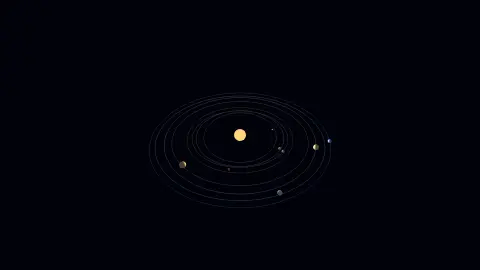
The Orrery screensaver places all eight planets using real orbital elements evaluated for the current date, with orbits drawn at their true inclinations. It runs in the browser with nothing to install; press ESC to exit.
Live preview
Press ESC to leave fullscreen. Settings are saved in your browser only.
How the Orrery screensaver works
The saver renders with three.js on your GPU. The library is vendored into this site rather than fetched from a CDN, and loads only when a 3D screensaver actually runs.
It reads nothing external — positions are computed in the browser from published Keplerian elements, so it works offline.
The scene resizes with the window and releases its WebGL context when the saver stops, so shuffle mode and Multi-view can cycle 3D savers without exhausting the browser's context limit.
If WebGL is unavailable the saver says so on screen rather than showing an empty black box.
Kepler's laws made into a working model
An orrery is a mechanical or digital model of the solar system. The name comes from Charles Boyle, 4th Earl of Orrery, for whom the instrument maker John Rowley made a copy of an earlier design around 1712. Traditional brass orreries use gears to turn planets around the Sun at the right relative speeds. A software version does the same job with mathematics instead of gears.
The mathematics goes back to Johannes Kepler, who found that planets move in ellipses with the Sun at one focus, sweep out equal areas in equal times, and have orbital periods that grow with distance in a fixed way. A set of Keplerian elements, a handful of numbers such as semi-major axis, eccentricity and inclination, pins down an orbit. Given a date, you solve Kepler's equation to find where on the ellipse the body is and then convert that to three-dimensional coordinates.
Real orbits are not perfect ellipses, since planets pull on each other, so a simple set of elements is only an approximation and precise ephemerides add corrections. Distances in the solar system are also extremely lopsided, since Neptune lies roughly thirty times farther from the Sun than Earth, which is why models often compress the scale to fit every planet on one screen.
A worked example
Each planet's mean anomaly advances from its J2000 epoch at its own orbital period, and Kepler's equation is solved by Newton iteration to convert that into a true position on an ellipse. The result is accurate to a fraction of a degree for dates near our own. Distances are logarithmic and this is stated rather than hidden: at true scale Neptune is thirty times Earth's distance and the inner planets would be an indistinguishable dot.
Settings & tips
- Accent and Background recolour the scene; Speed changes the pace of the motion and the camera.
- Add it to a Multi-view grid, though 3D savers are heavier than 2D ones and a few per screen is plenty.
- Press ESC at any time to leave fullscreen.
Frequently asked questions
- Why solve Kepler's equation at all?
- Because orbits are ellipses, not circles, and a planet moves faster near the Sun. The equation relates the time elapsed to the actual angle swept, and it has no closed-form solution — three Newton steps get well inside a pixel here.
- Is this accurate enough to observe by?
- No. It uses mean elements with linear rates and ignores planetary perturbations, so it is right to a fraction of a degree rather than the arcsecond an ephemeris gives. It is a picture of the arrangement, not a navigation tool.
- Does this need a special browser or plugin?
- No. It uses WebGL, which every current desktop and mobile browser supports. Nothing is installed and no plugin is required.
- Does it cost anything or need an account?
- No. Every screensaver here is free, runs in the browser and needs no sign-up.
- Why can't the planets just be spaced to scale?
- Neptune is roughly thirty times farther from the Sun than Earth, so at true scale the inner planets would cluster into a speck. Models therefore compress distances so that every orbit is visible.
- Do planets really travel in perfect ellipses?
- Only approximately. Mutual gravitational tugs between the planets slowly shift each orbit, which is why precise ephemerides add corrections to simple elements.
- Who built the first orrery?
- Clockmakers George Graham and Thomas Tompion are credited with an orrery dated about 1710. Graham gave the design to John Rowley, whose copy for the Earl of Orrery gave the device its name.