PLOS New Articles Screensaver
The PLOS New Articles screensaver streams real newly-published PLOS journal articles as they're reported. It is free, runs in your browser, and ESC exits.
Live preview
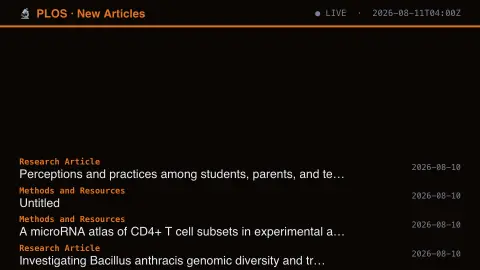
Press ESC to leave fullscreen. Settings are saved in your browser only.
How the PLOS New Articles screensaver works
The background pipeline polls PLOS's own Search API — a major open-access scientific publisher — every few minutes for new records.
Each new item eases up into its slot at the bottom of the list as it arrives.
A header shows a live/connecting indicator and the last update time.
No key is required for this key-less public endpoint.
About PLOS and its journals
PLOS, the Public Library of Science, is a nonprofit publisher of open-access journals. It was founded in 2000 by Harold Varmus, Michael Eisen and Patrick Brown, and its publishing began in October 2003 with PLOS Biology. Its titles today include PLOS ONE, PLOS Medicine, PLOS Computational Biology, PLOS Genetics, PLOS Pathogens and PLOS Neglected Tropical Diseases. Journal content is released under a Creative Commons attribution licence, so it can be reused with credit.
PLOS ONE, launched in December 2006, explains the breadth of what scrolls past. Its publication criteria centre on whether the research is rigorous and whether the data support the conclusions, and the journal states that it considers negative and null results too. A single feed can therefore mix ecology, engineering, psychology and clinical studies. The saver queries the PLOS Search API, a Solr-based interface whose indexed fields include title, author, journal and publication date.
Peer review is not a guarantee that a finding is settled; replication and follow-up work are part of normal science. A publication date marks when an article appeared, which can be long after the work itself was done.
A worked example
A real recent item scrolls into view with its details, then eases upward as newer ones arrive behind it.
Settings & tips
- PLOS publishes peer-reviewed research across science and medicine.
- Accent recolours the header and highlights.
- Every PLOS article is fully open access.
Frequently asked questions
- Is this real data?
- Yes — it's read live from PLOS's own Search API, a major open-access scientific publisher.
- Is a key needed?
- No. This is a fully key-less public API.
- How often does it refresh?
- The pipeline polls for new records every few minutes.
- Is it free?
- Yes — free, no download, in your browser.
- Are PLOS articles peer reviewed?
- PLOS journals use peer review. PLOS ONE’s published criteria ask whether the methods are rigorous and the conclusions are supported by the data, rather than asking editors to judge how novel a result is.
- Can I read the full articles for free?
- PLOS publishes open-access journals, and its content is released under a Creative Commons attribution licence, so the full text can be read and reused as long as the authors are credited.
- Why is the subject matter so varied?
- PLOS runs journals across many fields, and PLOS ONE covers a wide range of subjects, so the feed shifts topic from one article to the next.