Planetary Hours Clock Screensaver
The Planetary Hours Clock screensaver shows which classical planet really rules the current hour. It is free, runs in your browser, and ESC exits.
Live preview
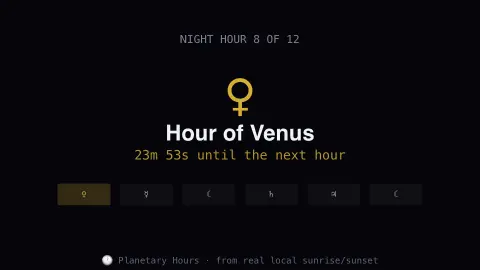
Press ESC to leave fullscreen. Settings are saved in your browser only.
How the Planetary Hours Clock screensaver works
The saver computes your city's real sunrise and sunset for today and tomorrow.
Daytime and nighttime are each split into 12 real planetary hours.
Hours cycle through the seven classical planets in their traditional order.
Everything is computed locally — no network, no key.
The Chaldean order and unequal hours
Planetary hours belong to an ancient astrological tradition. Each of the seven classical planets (Saturn, Jupiter, Mars, the Sun, Venus, Mercury and the Moon) is assigned to successive hours of the day. The order is called the Chaldean sequence, which runs from the slowest-moving planet in the sky to the fastest. The name is modern, and there is no evidence it comes from Babylonian astrology; the scheme is likely a Hellenistic development.
The first hour of each day belongs to that day's ruling planet, and the sequence simply continues through the 24 hours. Because 24 leaves a remainder of 3 when divided by 7, each day's first hour falls three places further along the order, which gives the weekday sequence behind many languages' names: Sunday for the Sun, Monday for the Moon, and so on.
The hours are temporal hours: the period from sunrise to sunset is divided into twelve equal parts, and the night into another twelve. Since day and night rarely have the same length, a daytime hour is longer than 60 minutes in summer and shorter in winter, with the reverse at night. Planetary hours are a cultural and historical practice; no scientific evidence supports a link between them and events or personal outcomes, so the clock is best enjoyed as a window into old timekeeping.
A worked example
Each real planetary hour's length changes with the season, since it is one-twelfth of the real day or night, not a fixed 60 minutes.
Settings & tips
- Planetary hours are unequal — their length tracks real day length.
- Location switches the real sunrise/sunset city used.
- The ruling order repeats: Saturn, Jupiter, Mars, Sun, Venus, Mercury, Moon.
Frequently asked questions
- Are planetary hours equal to 60 minutes?
- No — each is one-twelfth of the real local day or night, so length varies by season.
- How is sunrise/sunset computed?
- From a real local solar-altitude calculation for your chosen city, the same method as the Daylight Clock saver.
- Is a key needed?
- No. Everything is computed locally in your browser.
- Is it free?
- Yes — free, no download, in your browser.
- Why is the weekday linked to a planet?
- The first planetary hour of each day belongs to the day's ruler, and since 24 leaves a remainder of 3 over 7, the next day's first hour lands three places further along the Chaldean order, producing the weekday sequence.
- Why do the hours change length through the year?
- Because the sun's rise and set times change with season and latitude, so twelve equal slices of daylight or night get longer or shorter.
- Is this the same as time zones or solar time?
- No. It is a separate framework tied to sunrise and sunset, not to standard clock time.