Astrological Aspect Tracker Screensaver
The Astrological Aspect Tracker screensaver lists the real angles currently forming between the planets. It is free, runs in your browser, and ESC exits.
Live preview
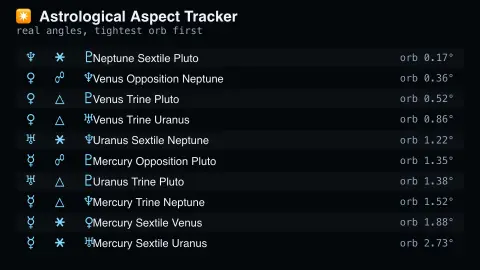
Press ESC to leave fullscreen. Settings are saved in your browser only.
How the Astrological Aspect Tracker screensaver works
The saver computes every planet's real geocentric ecliptic longitude.
It measures the real angular separation between every planet pair.
Separations within a real orb of a classical aspect angle are listed.
Everything is computed locally — no network, no key.
Angles on the ecliptic: the geometry of aspects
Seen from Earth, the planets appear to travel near the ecliptic, the Sun’s apparent path across the sky, against the backdrop of the zodiac. An aspect is a specific angular separation between two bodies, measured in degrees. The five classical aspects are the conjunction (0 degrees), sextile (60), square (90), trine (120) and opposition (180), often called the Ptolemaic aspects after the ancient astronomer and astrologer Ptolemy.
Position is expressed as ecliptic longitude, an angle from 0 to 360 degrees measured eastward from the vernal equinox point. Subtracting the longitudes of two planets and folding the result to a value between 0 and 180 gives their separation. Because a pair is rarely exactly on an aspect angle, astrologers allow a tolerance called an orb. Orbs vary by astrologer and by aspect; conjunctions and oppositions are commonly given wider orbs than sextiles, which often get only a few degrees.
The astronomy is verifiable, because planetary longitudes follow from orbital calculations. The meaning attached to the angles is not: astrological interpretation has no demonstrated predictive effect. Planets also sometimes seem to move backwards against the stars, called retrograde motion, an effect of viewing from a moving Earth, which is why a pair can pass the same aspect angle more than once.
A worked example
When two planets sit close to 90° apart in real longitude, the board lists a real square aspect between them.
Settings & tips
- The five classical aspects are conjunction, sextile, square, trine, opposition.
- Accent recolours the aspect glyphs and orb readout.
- A tighter real orb (closer to exact) is listed first.
Frequently asked questions
- What is an aspect?
- A real angular relationship between two planets' ecliptic positions, measured in degrees.
- What counts as an exact aspect?
- The real separation matching 0°, 60°, 90°, 120° or 180° within a small orb.
- Is a key needed?
- No. Everything is computed locally in your browser.
- Is it free?
- Yes — free, no download, in your browser.
- What is ecliptic longitude?
- An angle from 0 to 360 degrees measured along the ecliptic, starting from the vernal equinox point, which gives each planet’s position among the zodiac signs.
- What is an orb?
- The allowed deviation, in degrees, from an exact aspect angle within which the aspect is still counted. Astrologers use different orbs, so there is no single standard value.
- What does retrograde mean?
- A period when a planet seems to move backwards against the stars as seen from Earth, a perspective effect as Earth overtakes or is overtaken by another planet.