OpenAlex New Works Feed Screensaver
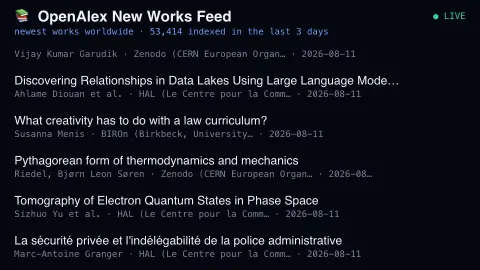
The OpenAlex New Works Feed screensaver scrolls the newest scholarly works to appear in OpenAlex, the open index of the world's research — real titles, first authors, venues and publication dates. It's free, needs an internet connection, and ESC exits.
Live preview
Press ESC to leave fullscreen. Settings are saved in your browser only.
How the OpenAlex New Works Feed screensaver works
The saver queries the key-less OpenAlex API straight from your browser for works published in the last few days, newest first.
Each row shows the real title, the first author with et al. when there are more, the venue or repository, and the publication date.
The header counts how many works OpenAlex has indexed in that window — usually a few million, which works out to a new record every few seconds.
It refreshes every five minutes, and copies sharing a screen share one request rather than each hitting the API.
OpenAlex and the index of research
OpenAlex is an open catalogue of scholarly works, authors, institutions and the sources that host works, such as journals and repositories, run by a non-profit called OurResearch. It began operating in January 2022 as a successor to the Microsoft Academic Graph, which stopped updating at the end of 2021, and it combines that legacy with data from sources such as Crossref, ORCID, DOAJ and Unpaywall. Its data is released under a CC0 dedication, which is why developers and researchers use it for bibliometric studies.
A record in the feed is a work, which can be a journal article, a preprint, a book chapter, a dataset or a thesis. The work type and the venue tell you a lot: a preprint repository is unrefereed, a journal is usually peer reviewed, and a dataset is not a paper at all. Author names and institutions come from the underlying sources, and matching them to author profiles is done automatically, so it is imperfect.
New records appear for several reasons: a paper may have just been published, or it may have only just been discovered or reprocessed by OpenAlex. The publication date and the date a record was added are therefore not identical. Titles may be in many languages. Appearing in the feed says nothing about quality, impact or correctness.
A worked example
You might see a Zenodo dataset, a Spanish-language education paper and a genomics preprint scroll past within seconds of each other — that's what "all of scholarship, newest first" actually looks like. For the other view of the same database, the site's Trending Research Papers board ranks recent work by citation count; run both side by side in Multi-view to see brand-new versus already-influential.
Settings & tips
- Scroll speed sets how fast the list creeps upward.
- Titles come through in whatever language they were registered in, which is a fair picture of global research output.
- A few OpenAlex records carry impossible future publication dates, so the saver asks for a rolling window ending today rather than an unfiltered newest-first sort.
Frequently asked questions
- Is this real research data?
- Yes — real work records straight from OpenAlex, the open scholarly index that replaced Microsoft Academic Graph.
- Does it need an API key?
- No. OpenAlex's works API is fully key-less and open; the browser calls it directly.
- How is this different from Trending Research Papers?
- That board ranks recent work by citation count, so it shows what has already made an impact. This is the newest-first firehose — papers, datasets and preprints that appeared in the index in the last few days, most of them uncited so far.
- Does it work offline?
- No. The feed is fetched live, so offline it shows a short notice instead.
- Is it free?
- Yes — free, no download, in your browser.
- Does OpenAlex only list peer-reviewed papers?
- No. It indexes preprints, books, datasets and other outputs alongside journal articles, so you have to look at the venue and type to judge whether review took place.
- Why do some records have no author or odd characters?
- Metadata arrives from many sources with varying care, so fields may be missing or contain encoding quirks.
- Who runs OpenAlex?
- The non-profit OurResearch, which has received philanthropic grant funding. The data is published under CC0, so it is free to reuse.