AlphaFold Predictions Screensaver
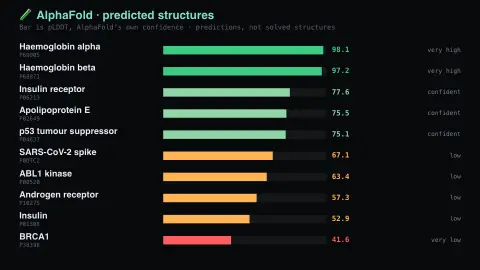
The AlphaFold Predictions screensaver shows predicted protein structures from the AlphaFold database at EMBL-EBI, ranked by pLDDT — AlphaFold's own confidence in each prediction. These are predictions, not experimentally solved structures. It's free, runs in your browser, and ESC exits.
Live preview
Press ESC to leave fullscreen. Settings are saved in your browser only.
How the AlphaFold Predictions screensaver works
The saver reads the AlphaFold database at EMBL-EBI directly in your browser — no key and no account.
Predicted protein structures from the AlphaFold database at EMBL-EBI, ranked by pLDDT — AlphaFold's own confidence in each prediction.
It refreshes on a schedule, so what you see stays current.
Colours can be changed in settings; nothing is stored beyond your own browser.
What pLDDT says about a predicted structure
AlphaFold is an artificial-intelligence system developed by Google DeepMind that predicts a protein’s three-dimensional shape from its amino acid sequence. The problem had been open for decades, because a protein is a chain that folds into a specific shape that determines what it does. The AlphaFold Protein Structure Database, developed by Google DeepMind and EMBL-EBI, makes the predictions freely available for a vast number of proteins from many organisms.
For each prediction AlphaFold reports a confidence score for every residue, called pLDDT, on a scale from 0 to 100. Higher values indicate the model is more sure of the local geometry; above 90 is the highest-confidence band, and below 50 is very low. Low-scoring regions are often flexible or intrinsically disordered stretches that may not have one fixed shape at all, so a low score can reflect real biology rather than a failure.
A structure is the model’s best estimate, not a measurement. pLDDT is a local measure, so a high score does not show that the relative positions of separate domains are reliable. A ranking by pLDDT shows how confident the model is, not how important the protein is.
A worked example
Predicted protein structures from the AlphaFold database at EMBL-EBI, ranked by pLDDT — AlphaFold's own confidence in each prediction. These are predictions, not experimentally solved structures.
Settings & tips
- Accent and Background recolour the display.
- Data comes straight from the AlphaFold database at EMBL-EBI in your browser.
- Press ESC to leave fullscreen.
Frequently asked questions
- Is this real data?
- Yes — it comes from the AlphaFold database at EMBL-EBI and is refreshed on a schedule.
- Are these real measured structures?
- No — they are predictions. The bar is pLDDT, AlphaFold's own confidence. The site's Protein Data Bank saver covers experimentally solved structures.
- Is a key needed?
- No. This source is fully key-less.
- Is it free?
- Yes — free, no download, in your browser.
- Does a high pLDDT mean the prediction is exactly right?
- It means the model has high confidence about the local structure. It is still a prediction, and pLDDT does not show whether the relative positions of domains are reliable.
- Why are some parts of a protein predicted with low confidence?
- They may be intrinsically disordered regions that lack a single stable shape, or regions with a predictable structure that AlphaFold lacks enough information to predict confidently, such as linkers between domains. Low confidence can be meaningful information.
- How are predictions different from experimental structures?
- Experimental structures come from methods such as X-ray crystallography or cryo-electron microscopy. AlphaFold’s are computed from sequence alone and are not a replacement for such measurements.