Top Research Institutions Screensaver
The Top Research Institutions screensaver shows the institutions whose published work has been cited most, from the key-less OpenAlex catalogue. Citation counts reward size and age as much as quality, so this maps research volume rather than merit. It's free, runs in your browser, and ESC exits.
Live preview
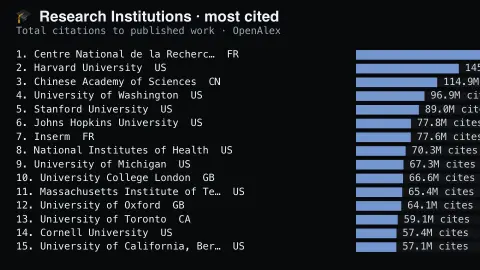
Press ESC to leave fullscreen. Settings are saved in your browser only.
How the Top Research Institutions screensaver works
The saver reads OpenAlex directly in your browser — no key and no account.
The institutions whose published work has been cited most, from the key-less OpenAlex catalogue.
It refreshes on a schedule, so what you see stays current.
Colours can be changed in settings; nothing is stored beyond your own browser.
Counting citations with OpenAlex
OpenAlex is an open index of the scholarly record that links works, authors, topics and institutions into one graph. It was built by the nonprofit OurResearch as a successor to Microsoft Academic Graph, and draws on open sources including Crossref. Each institution in it has its own OpenAlex ID and is grounded in a record in the Research Organization Registry (ROR), which supplies its canonical name, country, location and place in a parent and child hierarchy.
For each institution OpenAlex reports a cited-by count, the total number of citations across that institution’s works. Works list affiliations as raw text, and OpenAlex’s affiliation matcher parses those strings and links them to institutions. A cumulative total therefore favours older and larger institutions, which have had more time and more papers to collect citations, and a single hugely cited paper can lift a smaller institution a long way.
Because affiliation matching is automated, some papers may be attributed to the wrong organisation or split between records, and citation practices differ between fields. A cumulative count therefore maps the volume and age of research output, and it does not judge teaching, rigour or influence.
A worked example
The institutions whose published work has been cited most, from the key-less OpenAlex catalogue. Citation counts reward size and age as much as quality, so this maps research volume rather than merit.
Settings & tips
- Accent and Background recolour the display.
- Data comes straight from OpenAlex in your browser.
- Press ESC to leave fullscreen.
Frequently asked questions
- Is this real data?
- Yes — it comes from OpenAlex and is refreshed on a schedule.
- Is this a quality ranking?
- No. Citation totals reward institutions that are large and long-established, so this maps research volume rather than the merit of any individual work.
- Is a key needed?
- No. This source is fully key-less.
- Is it free?
- Yes — free, no download, in your browser.
- Why do big, old universities dominate?
- The count is the total citations across an institution’s works, so it grows with the number of papers and the time they have had to be cited, regardless of per-paper quality.
- What is the Research Organization Registry?
- ROR is a registry of persistent identifiers for research organisations. OpenAlex grounds each institution in a ROR record, which supplies its canonical name, country, location and hierarchy.
- How does OpenAlex link papers to institutions?
- Works list affiliations as raw text, and an affiliation matcher parses those strings and links them to institutions. Because that matching is automated, it can make mistakes.