Compound Card Screensaver
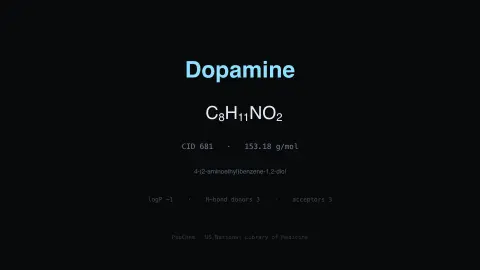
The Compound Card screensaver shows a rotating card of real chemistry from PubChem at the NIH, key-less: molecular formula with proper subscripts, weight, IUPAC name and hydrogen-bonding counts. It's free, runs in your browser, and ESC exits.
Live preview
Press ESC to leave fullscreen. Settings are saved in your browser only.
How the Compound Card screensaver works
The saver reads PubChem at the NIH directly in your browser — no key and no account.
A rotating card of real chemistry from PubChem at the NIH, key-less: molecular formula with proper subscripts, weight, IUPAC name and hydrogen-bonding counts..
It refreshes on a schedule, so what you see stays current.
Colours can be changed in settings; nothing is stored beyond your own browser.
About PubChem, the open chemistry database
PubChem is an open chemistry database run by the National Center for Biotechnology Information (NCBI), part of the US National Library of Medicine at the National Institutes of Health. It launched in 2004 and collects chemical information deposited by outside sources. Valid structures are standardised and stored in the PubChem Compound database, where each distinct structure receives a numeric Compound ID, or CID.
Standardising structures lets NCBI compute properties for each compound. The molecular formula gives the atom counts, and the molecular weight is derived from it. Hydrogen bond donor and acceptor counts tally the groups that can give or take a hydrogen atom in a hydrogen bond, which influences solubility and how a molecule binds to biological targets. The IUPAC name is a systematic name following naming rules set by the International Union of Pure and Applied Chemistry.
Properties like these are calculated from the structure, not measured in a lab, so they describe a theoretical molecule. A name or property on a card says nothing about safety, legality or biological effect, and PubChem holds a wide range of compounds, from familiar substances to obscure research chemicals.
A worked example
A rotating card of real chemistry from PubChem at the NIH, key-less: molecular formula with proper subscripts, weight, IUPAC name and hydrogen-bonding counts.
Settings & tips
- Accent and Background recolour the display.
- Data comes straight from PubChem at the NIH in your browser.
- Press ESC to leave fullscreen.
Frequently asked questions
- Is this real data?
- Yes — it comes from PubChem at the NIH and is refreshed on a schedule.
- Is a key needed?
- No. This source is fully key-less.
- Is it free?
- Yes — free, no download, in your browser.
- Are the properties measured or calculated?
- The ones shown, such as formula, weight and hydrogen-bond counts, are computed from the structure rather than measured experimentally.
- What is a CID?
- A Compound ID, the numeric identifier PubChem gives to each distinct standardised chemical structure in its Compound database.
- Why do hydrogen bond counts matter?
- They influence how a molecule dissolves and interacts with biological targets, which is why chemists consider them when judging how a molecule may behave.