Open Access, As It Appears Screensaver
The Open Access, As It Appears screensaver streams newly indexed open-access publications from OpenAIRE, which aggregates institutional repositories across Europe and beyond. The feed is genuinely multilingual: a Portuguese thesis, a German working paper and a Japanese conference abstract arrive in the same minute. It runs in the browser with nothing to install; press ESC to exit.
Live preview
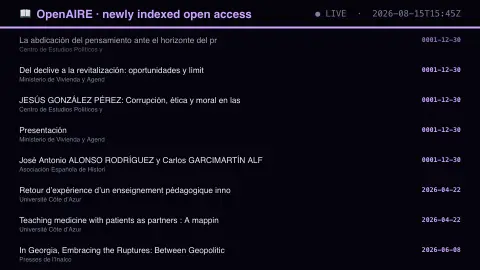
Press ESC to leave fullscreen. Settings are saved in your browser only.
How the Open Access, As It Appears screensaver works
The saver reads The OpenAIRE search API, ordered in this site's pipeline.
No account and no key: the request goes straight from your browser, or from this site's own refreshed copy of the feed where the source does not allow browser access.
Values are drawn on a canvas that resizes with the window, so it works on a laptop or a wall display.
If the source is unreachable the saver says so on screen rather than showing stale numbers as though they were current.
OpenAIRE and the open-access research graph
OpenAIRE is a European infrastructure whose Graph describes itself as one of the largest open scholarly record collections worldwide. It aggregates metadata from sources such as DOAJ-listed open-access journals, Crossref, DataCite, ORCID and repositories like arXiv, HAL, Zenodo and Figshare. Besides papers, it links research products to the projects, funders and organisations behind them, which is one reason it matters to research agencies that mandate open access.
The word indexed is the key one. A record appears when OpenAIRE collects it from a source, which can be well after the work was written, and the dates attached depend on what each source supplied. Dates in aggregated metadata are often incomplete, which is why this feed needs some tidying before it can be sorted newest-first.
Because the sources are many, the records cover articles, datasets, software and other research products. A listing is a metadata record with links, not the work itself, and quality varies with how carefully each source describes its holdings.
A worked example
Each row is a title with its publisher beneath and the acceptance date on the right. The ordering is done in the pipeline rather than by the API: asking OpenAIRE to sort by acceptance date descending returns every record carrying the 9999-12-31 placeholder first, and there are enough of those to fill the page with nothing real.
Settings & tips
- Accent and Background recolour the display without changing the data.
- Add it to a Multi-view grid to watch it alongside other live savers.
- Press ESC at any time to leave fullscreen.
Frequently asked questions
- What counts as open access here?
- Anything OpenAIRE has indexed from a participating repository, which includes journal articles, theses, preprints and conference papers deposited by universities and research institutions.
- Why are so many titles not in English?
- Because the repositories are national. OpenAIRE indexes institutional archives across dozens of countries, and researchers deposit in the language they published in.
- Is this real data?
- Yes. It comes from The OpenAIRE search API, ordered in this site's pipeline. Nothing is invented or simulated, and if the source cannot be reached the saver reports that instead of drawing something plausible.
- Does it cost anything or need an account?
- No. Every screensaver here is free, runs in the browser and needs no sign-up. This one uses a public API that requires no key.
- Is a publication here the same as a peer-reviewed paper?
- Not necessarily. OpenAIRE aggregates many kinds of research products from repositories and journals, so an item is not guaranteed to have been through journal peer review.
- Why can a new item look like it was written years ago?
- The date shown reflects what the source supplied, and indexing can lag the actual writing or publication by a long time. A repository can also add older material only now.
- Does OpenAIRE host the full texts?
- The Graph is mainly metadata and links, with the work itself held by the originating repository or publisher. That is why availability and licence terms differ from item to item.