Obesity Prevalence Board Screensaver
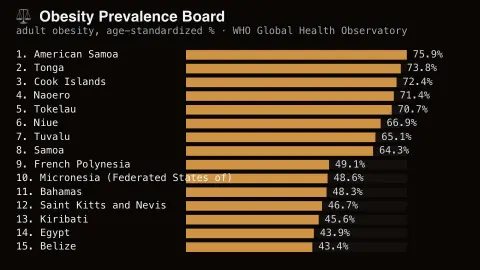
The Obesity Prevalence Board screensaver ranks real age-standardized adult obesity prevalence by country. It is free, runs in your browser, and ESC exits.
Live preview
Press ESC to leave fullscreen. Settings are saved in your browser only.
How the Obesity Prevalence Board screensaver works
The saver reads real age-standardized adult obesity prevalence data from the WHO's own Global Health Observatory API.
Countries are ranked by their real latest reported obesity rate.
The pipeline refreshes on the WHO's own periodic release schedule.
No key is required for this key-less public endpoint.
How obesity prevalence is measured
The figure on each row is the share of adults aged 18 and over classed as obese, age-standardised so that countries with younger or older populations can be compared fairly. Obesity here means a body mass index of 30 kg/m² or higher, where BMI is weight in kilograms divided by height in metres squared. Age-standardised prevalence is a weighted average of age-specific rates, with weights set by the age-group shares of the WHO standard population.
The numbers come from the WHO Global Health Observatory, which publishes modelled estimates rather than raw national headcounts. The indicator's source is the NCD Risk Factor Collaboration, which uses measured height and weight from population-based surveys and combines them with a Bayesian hierarchical meta-regression that accounts for differing data availability across countries and years. That is why countries with sparse survey coverage can still be given an estimate, with an uncertainty interval.
Read it as a population-level indicator, not a judgement on individuals. BMI ignores muscle, fat distribution and body frame, and a country's rank can shift between releases when the underlying survey data or the model is revised.
A worked example
A real country's most recent reported obesity rate is ranked against the real others, with bars easing into place as the board loads.
Settings & tips
- Values and years are real, unedited WHO Global Health Observatory data.
- Accent recolours the bars and header text.
- The GHO is the WHO's own real global health-statistics repository.
Frequently asked questions
- Is this real health data?
- Yes — real age-standardized adult obesity prevalence figures from the WHO's own Global Health Observatory API.
- Is a key needed?
- No. The GHO OData API is fully key-less.
- How often does it update?
- The pipeline re-reads the WHO's own dataset periodically, on whatever schedule WHO republishes that indicator.
- Is it free?
- Yes — free, no download, in your browser.
- What does age-standardised mean?
- Rates are weighted to a common reference age structure, the WHO standard population, so a country is not ranked higher or lower simply because it has more older or younger adults.
- Are these counts from national headcounts?
- No. They are modelled estimates built from population-based surveys with measured height and weight, combined statistically to cover countries and years with sparse data.