Diabetes Risk Board Screensaver
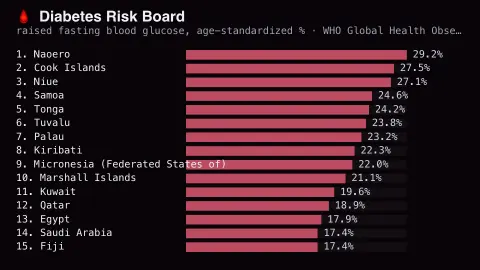
The Diabetes Risk Board screensaver ranks real raised fasting blood glucose prevalence (a diabetes-risk proxy) by country. It is free, runs in your browser, and ESC exits.
Live preview
Press ESC to leave fullscreen. Settings are saved in your browser only.
How the Diabetes Risk Board screensaver works
The saver reads real raised fasting blood glucose prevalence (a diabetes-risk proxy) data from the WHO's own Global Health Observatory API.
Countries are ranked by their real latest reported blood glucose prevalence.
The pipeline refreshes on the WHO's own periodic release schedule.
No key is required for this key-less public endpoint.
Raised blood glucose as a stand-in for diabetes
Counting how many people in a country have diabetes is hard, because many cases are undiagnosed. WHO's Global Health Observatory therefore carries a measurable proxy: the age-standardised percentage of people with raised fasting blood glucose, defined in WHO-derived reports as a fasting value of 7.0 mmol/L or above, or being on medication for raised glucose. Age standardisation adjusts figures to a common age structure so that a young country and an old one can be compared fairly.
Because the indicator is a modelled estimate, not a count of diagnoses, each country is shown with a year attached. The entries on this board, such as Nauru (listed as Naoero), Cook Islands and Niue, carry the year 2014, which is the year of the data in the indicator the board reads; it reflects the dataset, not a live reading, and newer releases may exist.
This board describes populations, not individuals. Raised glucose is not the same as a diagnosis, and anyone with questions about their own health should speak to a clinician. The ranking shows how the estimates compare between countries, not why they differ.
A worked example
A real country's most recent reported blood glucose prevalence is ranked against the real others, with bars easing into place as the board loads.
Settings & tips
- Raised fasting blood glucose is a standard WHO diabetes-risk indicator.
- Accent recolours the bars and header text.
- Values and years are real, unedited WHO Global Health Observatory data.
Frequently asked questions
- Is this real health data?
- Yes — real raised fasting blood glucose prevalence (a diabetes-risk proxy) figures from the WHO's own Global Health Observatory API.
- Is a key needed?
- No. The GHO OData API is fully key-less.
- How often does it update?
- The pipeline re-reads the WHO's own dataset periodically, on whatever schedule WHO republishes that indicator.
- Is it free?
- Yes — free, no download, in your browser.
- Is this the share of people diagnosed with diabetes?
- No. It is the age-standardised prevalence of raised fasting glucose, which includes people who have never been diagnosed, and it is used as a proxy for diabetes burden.
- Why does the board show 2014?
- 2014 is the year attached to the values in the WHO indicator the board reads. It describes that dataset, not today's conditions.