Maternal Mortality Board Screensaver
The Maternal Mortality Board screensaver ranks real maternal mortality ratios per 100,000 live births by country. It is free, runs in your browser, and ESC exits.
Live preview
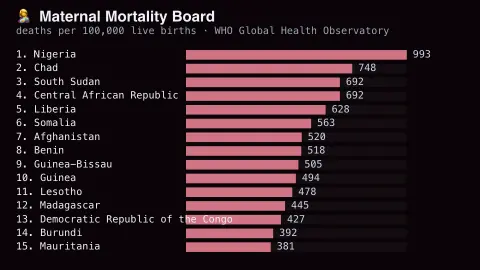
Press ESC to leave fullscreen. Settings are saved in your browser only.
How the Maternal Mortality Board screensaver works
The saver reads real maternal mortality ratios per 100,000 live births data from the WHO's own Global Health Observatory API.
Countries are ranked by their real latest reported maternal mortality ratio.
The pipeline refreshes on the WHO's own periodic release schedule.
No key is required for this key-less public endpoint.
How maternal mortality ratios are produced
The maternal mortality ratio is the number of maternal deaths per 100,000 live births. Under the WHO definition, a maternal death is the death of a woman while pregnant or within 42 days of the end of the pregnancy, from any cause related to or aggravated by the pregnancy or its management, but not from accidental or incidental causes.
The country figures come from the United Nations Maternal Mortality Estimation Inter-Agency Group, made up of WHO, UNICEF, UNFPA, the World Bank Group and the UN Population Division, and are published through the WHO Global Health Observatory. They are modelled estimates reported with uncertainty intervals, not simple head counts, and each round of estimates refines the input data and methods of the previous one.
The latest round, covering 2000 to 2023, put the global ratio at 197 per 100,000 live births, with about 260,000 women dying in 2023. Sustainable Development Goal target 3.1 aims for a global ratio below 70 by 2030. The ratio describes a population, not an individual’s risk, and because estimates are revised between rounds, ratios from different editions should not be lined up against each other.
A worked example
A real country's most recent reported maternal mortality ratio is ranked against the real others, with bars easing into place as the board loads.
Settings & tips
- The ratio is deaths per 100,000 live births, the WHO's standard measure.
- Accent recolours the bars and header text.
- Values and years are real, unedited WHO Global Health Observatory data.
Frequently asked questions
- Is this real health data?
- Yes — real maternal mortality ratios per 100,000 live births figures from the WHO's own Global Health Observatory API.
- Is a key needed?
- No. The GHO OData API is fully key-less.
- How often does it update?
- The pipeline re-reads the WHO's own dataset periodically, on whatever schedule WHO republishes that indicator.
- Is it free?
- Yes — free, no download, in your browser.
- Why per live births and not per women?
- Live births are used as the denominator because they serve as a practical stand-in for the number of women at risk of a maternal death in a given year. A separate measure, lifetime risk, gives the probability that a 15-year-old woman will eventually die from a maternal cause.
- Are the numbers exact?
- No. They are modelled estimates published with uncertainty intervals, so small differences between countries should not be over-read, and values can change when a new round of estimates is released.