How Far Back Records Go Screensaver
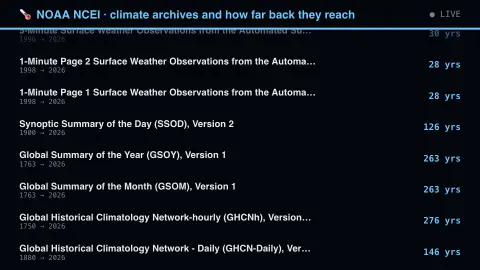
The How Far Back Records Go screensaver shows climate datasets held by NOAA's National Centers for Environmental Information, key-less. The start dates are the point: the Global Historical Climatology Network reaches back to 1880 daily and 1750 hourly, and a climate archive is only as useful as its baseline is long, so the span in years is drawn beside each one. It's free, runs in your browser, and ESC exits.
Live preview
Press ESC to leave fullscreen. Settings are saved in your browser only.
How the How Far Back Records Go screensaver works
The saver reads the source described above and draws it on a canvas — no account, no tracking.
Climate datasets held by NOAA's National Centers for Environmental Information, key-less. The start dates are the point: the Global Historical Climatology Network reaches back to 1880 daily and 1750 hourly, and a climate archive is only as useful as its baseline is long, so the span in years is drawn beside each one.
It refreshes on a schedule, so what you see stays current.
Colours can be changed in settings; nothing is stored beyond your own browser.
The archive behind the weather record
NOAA's National Centers for Environmental Information (NCEI) was formed in 2015 by combining several earlier NOAA data centres, among them the National Climatic Data Center and the National Geophysical Data Center. It describes itself as a provider of environmental data, products and services covering the depths of the ocean to the surface of the sun, and its archive holds more than 60 petabytes of data.
The saver lists archive datasets together with how far their records extend, which matters because climate is judged over long periods rather than single days. Take GHCN-Daily, one of NCEI's station datasets: its station records range from under a year to more than 175 years, with an average of more than four decades. Station counts were low before 1890 and peaked in the 1960s, so a dataset's start date is only the earliest reach of a few stations, not a promise of global coverage from that year.
Long records also need care. GHCN-Daily is not bias-adjusted or homogenised for changes in instruments or observing practices, so users have to consider whether systematic bias could affect their analysis. Automated quality-assurance tests flag about 0.3 percent of its nearly two billion values as suspect. The span drawn beside each dataset marks the potential reach of the archive, not uniform quality throughout.
A worked example
Climate datasets held by NOAA's National Centers for Environmental Information, key-less. The start dates are the point: the Global Historical Climatology Network reaches back to 1880 daily and 1750 hourly, and a climate archive is only as useful as its baseline is long, so the span in years is drawn beside each one.
Settings & tips
- Accent and Background recolour the display.
- Every value on screen comes from the live source — nothing is simulated.
- Press ESC to leave fullscreen.
Frequently asked questions
- Is this real data?
- Yes — it comes from the source named on this page and is refreshed on a schedule.
- Is a key needed?
- No. This source is fully key-less.
- Is it free?
- Yes, and it runs entirely in your browser.
- Does a longer record always mean better coverage?
- No. In GHCN-Daily, station counts were low before 1890 and peaked in the 1960s, so early decades rest on far fewer stations than later ones.
- Is the daily station data adjusted for station moves or new instruments?
- Not in GHCN-Daily. NCEI states it is not bias-adjusted or homogenised, so users should consider whether systematic bias could affect their analysis.
- Where does GHCN-Daily get its observations?
- From four groups of sources: a U.S. collection, an international collection, data exchanged with national governments, and Global Summary of the Day for gaps.