Climate Clock Screensaver
The Climate Clock screensaver is a live clock counting down the time left in the global carbon budget for 1.5 °C, alongside the share of the world's energy from renewables, computed on your device. It's free, runs in your browser, and ESC exits.
Live preview
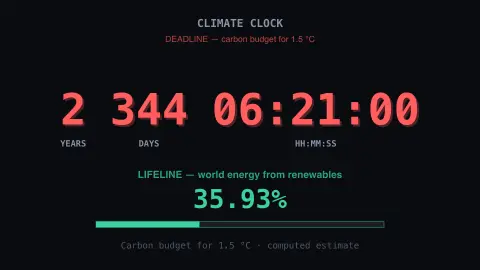
Press ESC to leave fullscreen. Settings are saved in your browser only.
How the Climate Clock screensaver works
The saver counts down to the moment the world's carbon budget for limiting warming to 1.5 °C is projected to run out, the way the public Climate Clock does.
The deadline ticks down in years, days, hours, minutes and seconds, updating every second on your device.
Below it, a green lifeline shows the rising share of the world's energy that comes from renewables.
Everything is computed locally from published figures, so it needs no connection.
What a carbon budget countdown means
A carbon budget is the amount of carbon dioxide that can still be emitted if warming is to stay below a chosen limit. It rests on the finding, set out in Intergovernmental Panel on Climate Change assessments, that global temperature rise is roughly proportional to the total cumulative CO₂ emitted. The Climate Clock’s deadline follows the same logic: it takes the remaining budget for a stated chance of holding warming to 1.5 °C and divides it by the current rate of emissions, giving the time the present pace could continue.
The result is sensitive to choices. The budget depends on the temperature target, the probability of meeting it and which gases and Earth-system feedbacks are counted, so published estimates differ and are revised as science and measured emissions change. The countdown is a communication device, not a forecast of a particular day on which something happens, and it assumes emissions stay at their current rate.
The renewable share shown alongside is a separate indicator: the portion of total energy, not just electricity, that comes from renewable sources. Electricity generally has a higher renewable share than energy overall, because transport, heating and industry still rely heavily on fuels. Neither figure alone says how fast the transition is going or how much warming has already occurred.
A worked example
The red countdown ticks down second by second — years, days and a live clock to the 1.5 °C carbon deadline — while the green lifeline beneath shows renewables climbing past 34% of world energy, the two numbers racing each other.
Settings & tips
- Deadline color recolours the countdown.
- Background sets the panel backdrop.
- Both figures are computed locally, so it runs offline.
Frequently asked questions
- Where does the deadline come from?
- It mirrors the public Climate Clock — the projected time until the carbon budget for 1.5 °C of warming is used up, based on published estimates.
- Is it exact?
- No — it's an estimate computed from public figures, like the real Climate Clock. It conveys the trend, not a precise instant.
- Does it need a connection?
- No. Both the deadline and the renewables figure are computed on your device, so it runs fully offline.
- What is the green number?
- It's the lifeline — the share of the world's energy coming from renewables — rising as the deadline falls.
- Is it free?
- Yes — free, no download, no key, in your browser.
- What does 1.5 degrees refer to?
- It comes from the 2015 Paris Agreement, which aims to hold the global average temperature rise to well below 2 degrees Celsius above pre-industrial levels and to pursue efforts to limit it to 1.5 degrees.
- Why do carbon budget estimates differ?
- They depend on the probability of meeting the target, how other greenhouse gases and feedbacks are counted, and the emissions data used, and they are revised as new data arrives.
- Is renewable energy share the same as electricity share?
- No. Renewables supply a larger share of electricity than of total energy, which also includes transport fuels, heating and industrial processes.