Heat Wave Records Board Screensaver
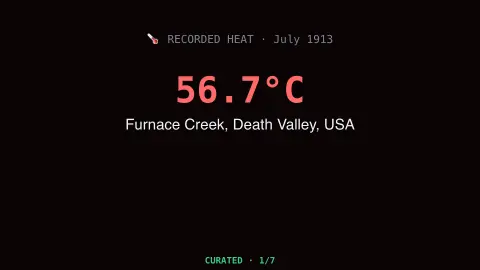
The Heat Wave Records Board screensaver rotates through real, curated record-breaking heat wave events from around the world. It is free, runs in your browser, and ESC exits.
Live preview
Press ESC to leave fullscreen. Settings are saved in your browser only.
How the Heat Wave Records Board screensaver works
The saver displays a real, curated record of notable heat wave events, drawn from published meteorological reporting.
Each entry shows the real location, real recorded temperature and real date.
Entries rotate through the record on a timer.
No live feed is required — the record is a real, curated historical archive.
What makes a heat wave a record
There is no single worldwide definition of a heat wave. The IPCC describes one as a period of abnormally hot weather, often defined with reference to a relative temperature threshold, and national weather services set their own rules. Some use a run of days above a fixed temperature, others combine daytime highs with night-time minimums or with humidity. A temperature that is routine in one place can therefore be extraordinary in another.
A record can mean different things. It may be an all-time high for a station, a high for a given calendar day, a national record or a regional one. A station record is only the hottest value in that station's observation history, which varies in length. For the most extreme claims, the World Meteorological Organization maintains an Archive of Weather and Climate Extremes (created in 2007) containing records its evaluation committee has formally evaluated and recognised.
Heat is also felt differently depending on humidity and night-time temperature, which is why some national warning systems, such as the UK's, look at nightly minimums as well as daily highs. The entries here are a curated historical set and not a live monitoring service.
A worked example
A real record-setting temperature reading appears in rotation with its real recorded date and location, exactly as reported by meteorological services.
Settings & tips
- Accent recolours the event cards.
- Entries are real, well-documented recorded temperature extremes.
- The record updates periodically as new real events occur.
Frequently asked questions
- Are these real recorded temperatures?
- Yes — every entry is a real, well-documented recorded temperature extreme.
- Is a key needed?
- No — the record is a curated real historical archive.
- Is this a live weather alert?
- No — it is a curated historical record of past extremes, not a live forecast.
- Is it free?
- Yes — free, no download, in your browser.
- Is there an official definition of a heat wave?
- Not a universal one. The IPCC describes a heat wave as abnormally hot weather, often defined relative to a threshold, and weather services set their own criteria for their regions.
- Who verifies temperature records?
- For extreme records, the World Meteorological Organization keeps an archive of weather and climate extremes that includes records its evaluation committee has formally evaluated and recognised.
- Why do night-time temperatures matter?
- Some national heat-wave criteria include a night-time minimum as well as a daytime maximum, because heat that does not ease overnight is part of what makes a heat wave hard to cope with.