Active Weather Alerts Board Screensaver
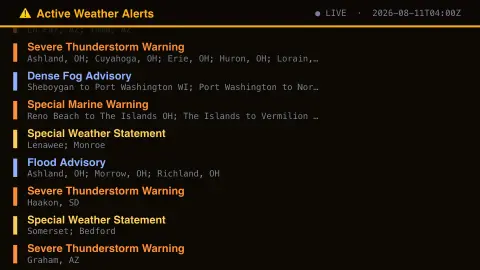
The Active Weather Alerts Board screensaver streams real active US weather watches and warnings. It is free, runs in your browser, and ESC exits.
Live preview
Press ESC to leave fullscreen. Settings are saved in your browser only.
How the Active Weather Alerts Board screensaver works
The saver reads real currently-active alerts from the National Weather Service's own public API.
Each entry shows a real alert type, severity and affected area.
The pipeline refreshes the feed regularly as alerts are issued or expire.
No key is required for this key-less public endpoint.
Watch, warning, advisory: the vocabulary of NWS alerts
The US National Weather Service issues alerts through its local forecast offices, and its public API can return them in the Common Alerting Protocol (CAP), an open standard format for emergency alerts. Each alert is tied to a defined area, such as a county or forecast zone, and has an expiry time, after which it leaves the active list.
The product names carry specific meanings. A watch signals that the risk of a hazardous event has risen considerably, though its timing and location are uncertain. A warning means a hazard is occurring, imminent or highly likely. An advisory covers events that are a nuisance rather than dangerous. Alerts also carry CAP fields: severity (Extreme, Severe, Moderate, Minor), urgency (Immediate, Expected, Future, Past) and certainty (Observed, Likely, Possible, Unlikely). Severity rates the threat to life or property, urgency the time available to respond, and certainty the confidence that the event will occur.
The list is a national snapshot, so it mixes many kinds of hazard, and at any moment large areas may have none. Alerts are updated, extended or cancelled as conditions change. Anyone who needs to act on the weather should rely on official local sources such as weather.gov, emergency messages and local authorities, and not on a decorative display.
A worked example
A real severe thunderstorm warning for a real named area scrolls past exactly as the National Weather Service issued it.
Settings & tips
- Alerts are real, official National Weather Service issuances.
- Accent recolours the ticker text.
- The feed can be quiet during calm weather — that's real, not a bug.
Frequently asked questions
- Is this real weather data?
- Yes — real active alerts from the National Weather Service's own API.
- Is a key needed?
- No. The NWS alerts API is fully key-less.
- Should I rely on this for safety?
- No — always use official NWS channels directly for real emergencies.
- Is it free?
- Yes — free, no download, in your browser.
- What is the difference between a watch and a warning?
- A watch says the risk of a hazardous event has risen but its timing and location are uncertain, while a warning says a hazard is occurring, imminent or highly likely.
- What does the severity field mean?
- It rates the threat to life or property, from Minor up to Extreme, and is separate from the urgency and certainty fields.
- Why do alerts disappear?
- Each alert has an expiry time, and forecasters can also cancel or replace it as the weather evolves.