Rocks Nobody Has Confirmed Screensaver
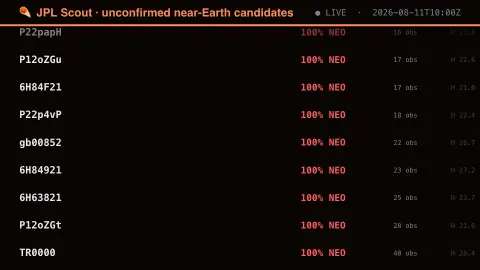
The Rocks Nobody Has Confirmed screensaver shows unconfirmed near-Earth object candidates from JPL Scout, key-less. Scout works the queue of things a survey picked up in the last few nights that have not yet been designated. The NEO score is the probability it is a near-Earth object at all, and the observation count beside it is how much evidence that judgement rests on — a score of 100 from six observations is a fast guess, not a certainty. It's free, runs in your browser, and ESC exits.
Live preview
Press ESC to leave fullscreen. Settings are saved in your browser only.
How the Rocks Nobody Has Confirmed screensaver works
The saver reads the source described above and draws it on a canvas — no account, no tracking.
Unconfirmed near-Earth object candidates from JPL Scout, key-less. Scout works the queue of things a survey picked up in the last few nights that have not yet been designated. The NEO score is the probability it is a near-Earth object at all, and the observation count beside it is how much evidence that judgement rests on — a score of 100 from six observations is a fast guess, not a certainty.
It refreshes on a schedule, so what you see stays current.
Colours can be changed in settings; nothing is stored beyond your own browser.
Scout, the pre-confirmation queue for asteroids
JPL Scout is a tool of the Center for Near-Earth Object Studies (CNEOS), a NASA/JPL/Caltech project. It monitors the Minor Planet Center's Near-Earth Object Confirmation Page, which lists newly detected objects that are not yet confirmed and whose designations are unofficial. For each one Scout provides orbit and ephemeris information, including the number of observations, the arc length and rough estimates of size, closest-approach distance and similar quantities.
Because the observations are so sparse, many orbits fit the same data. Scout assigns scores from 0 to 100 for several orbit classes, including near-Earth object, and a higher NEO score means a higher likelihood that the object is one. Scout's own documentation says these scores are meant to flag interesting objects, not to serve as rigorous probabilities, since the arcs are short and the astrometry can be imprecise.
Candidates are short-lived on this list. If enough additional observations confirm that the object is real, the Minor Planet Center gives it an official designation and it leaves the confirmation page and Scout. Objects that stay unconfirmed are eventually removed too. Absence from the list therefore says nothing about an object's fate, and the page reflects a snapshot of an active triage process.
A worked example
Unconfirmed near-Earth object candidates from JPL Scout, key-less. Scout works the queue of things a survey picked up in the last few nights that have not yet been designated. The NEO score is the probability it is a near-Earth object at all, and the observation count beside it is how much evidence that judgement rests on — a score of 100 from six observations is a fast guess, not a certainty.
Settings & tips
- Accent and Background recolour the display.
- Every value on screen comes from the live source — nothing is simulated.
- Press ESC to leave fullscreen.
Frequently asked questions
- Is this real data?
- Yes — it comes from the source named on this page and is refreshed on a schedule.
- Is a key needed?
- No. This source is fully key-less.
- Is it free?
- Yes, and it runs entirely in your browser.
- What happens to an object after it leaves Scout?
- If more observations confirm it is a real asteroid, the Minor Planet Center gives it an official designation. Objects that remain unconfirmed are eventually removed from the confirmation page and from Scout.
- Does a high NEO score mean an impact risk?
- No. It means the object is likely to be a near-Earth object. Scout also gives a separate impact rating, but it is not defined for very short arcs or for objects with fewer than three observations.