Asteroid Impact Risk Screensaver
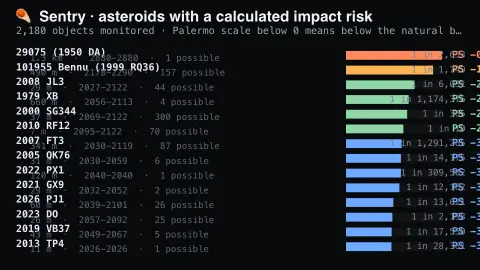
The Asteroid Impact Risk screensaver shows the asteroids JPL's Sentry system tracks because they carry a calculated, non-zero chance of hitting Earth, ranked by Palermo scale. Every object listed scores below the natural background risk, and none of this is a prediction. It's free, runs in your browser, and ESC exits.
Live preview
Press ESC to leave fullscreen. Settings are saved in your browser only.
How the Asteroid Impact Risk screensaver works
The background pipeline reads this from NASA/JPL Sentry and saves a snapshot the saver loads.
The asteroids JPL's Sentry system tracks because they carry a calculated, non-zero chance of hitting Earth, ranked by Palermo scale.
It refreshes on a schedule, so what you see stays current.
Colours can be changed in settings; nothing is stored beyond your own browser.
How JPL's Sentry system watches near-Earth asteroids
Sentry is NASA’s impact-monitoring system, part of the Center for Near-Earth Object Studies (CNEOS) at the Jet Propulsion Laboratory. It propagates the motion of near-Earth asteroids forward for at least 100 years to look for possible close approaches. Because telescope measurements have errors, an asteroid’s future path is not a single line but a cloud of possible orbits, each represented by a virtual asteroid, and a virtual impactor is one whose path would carry it within one Earth radius of Earth’s center.
An object is listed when at least one virtual impactor has a non-zero probability. Most newly listed objects are later removed: as more observations arrive, the orbit improves, the range of possible paths narrows, and the impact risk is ruled out. JPL describes this as normal and expected, not as a sign the first assessment was wrong. A listing is therefore usually a sign of limited data, not of danger.
The Palermo scale is the base-10 logarithm of the impact’s probability divided by the background risk, which is the average risk from random impacts by objects of the same or larger size over the years remaining until the event. A value below zero means the risk is lower than that background, and positive values are very rare. The Torino scale, from 0 to 10, is the one designed for communicating with the public.
A worked example
The asteroids JPL's Sentry system tracks because they carry a calculated, non-zero chance of hitting Earth, ranked by Palermo scale. Every object listed scores below the natural background risk, and none of this is a prediction.
Settings & tips
- Accent and Background recolour the display.
- Run
automation/run.py sentryriskto refresh the feed. - Press ESC to leave fullscreen.
Frequently asked questions
- Is this real data?
- Yes — it comes from NASA/JPL Sentry and is refreshed on a schedule.
- Is any of this going to hit us?
- No object here is a prediction. Palermo scale compares an object against the ordinary background chance of a similar impact, and every entry on the list scores below that background — meaning less concerning than the natural rate.
- Is a key needed?
- No. This source is fully key-less.
- Is it free?
- Yes — free, no download, in your browser.
- What is a virtual impactor?
- It is one possible orbit, consistent with the observations, whose path would bring the asteroid within one Earth radius of Earth’s center, so it could strike the planet. Each such possibility contributes to the object’s overall impact probability.
- Why do asteroids disappear from the list?
- More observations improve the orbit and narrow the range of possible paths, and in most cases the impact risk is ruled out. The object is then removed, which JPL describes as a normal, expected process.
- What is the difference between the Palermo and Torino scales?
- The Palermo scale is a technical, logarithmic comparison of an impact’s risk with the background risk. The Torino scale uses whole numbers from 0 to 10 and is designed to help communicate impact risk to the public.