The Norwegian Forecast Screensaver
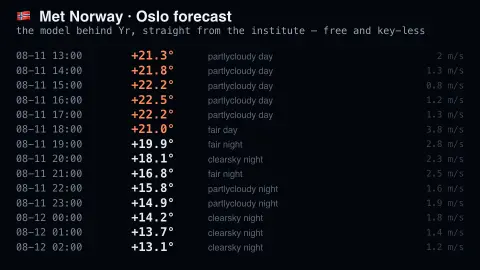
The The Norwegian Forecast screensaver shows met Norway's locationforecast, key-less — the model output behind the Yr apps, unmediated. The symbol codes are Yr's own vocabulary, which distinguishes things most forecast APIs flatten into "rain". It's free, runs in your browser, and ESC exits.
Live preview
Press ESC to leave fullscreen. Settings are saved in your browser only.
How the The Norwegian Forecast screensaver works
The saver reads the source described above and draws it on a canvas — no account, no tracking.
Met Norway's locationforecast, key-less — the model output behind the Yr apps, unmediated. The symbol codes are Yr's own vocabulary, which distinguishes things most forecast APIs flatten into "rain".
It refreshes on a schedule, so what you see stays current.
Colours and any options can be changed in settings; nothing is stored beyond your own browser.
Reading MET Norway's locationforecast
MET Norway, the Norwegian Meteorological Institute, publishes its forecasts as open data, and locationforecast is the service that returns a point forecast for a latitude and longitude anywhere on Earth. It is the model output that feeds the Yr apps. The service has the most data for the Nordic region, so detail is greatest there.
A response is a time series: in the Nordic short-range forecast the steps are one hour apart, and in the medium range they are six hours apart. The fields use metric units, with temperature in degrees Celsius, wind speed in metres per second and precipitation in millimetres. Beside the numbers, the service provides a symbol_code such as partlycloudy_day, matching MET Norway’s weather icon set, with day, night and polar variants so that clients do not have to work out daylight themselves.
Like any model forecast, the output gets less reliable the further ahead it looks, and local effects such as fjords and mountains may not be resolved. The service is not suitable for forecasts above ground level, and clients must send a User-Agent header with a unique identifier or the request is refused with a 403 error.
A worked example
Met Norway's locationforecast, key-less — the model output behind the Yr apps, unmediated. The symbol codes are Yr's own vocabulary, which distinguishes things most forecast APIs flatten into "rain".
Settings & tips
- Place changes what the saver shows.
- Accent and Background recolour the display.
- Every value on screen comes from the live source — nothing is simulated.
- Press ESC to leave fullscreen.
Frequently asked questions
- Is this real data?
- Yes — it comes from the source named on this page and is refreshed on a schedule.
- Is a key needed?
- No. This source is fully key-less.
- Is it free?
- Yes, and it runs entirely in your browser.
- How is this related to the Yr app?
- Yr draws on the same MET Norway model output, so this view shows the forecast without the app’s presentation.
- What units does the forecast use?
- Temperature in Celsius, wind speed in metres per second and precipitation in millimetres.
- Why must clients identify themselves?
- MET Norway’s API refuses requests with a missing or generic User-Agent, and requires a unique identifier in it.