A German Station, Reporting Screensaver
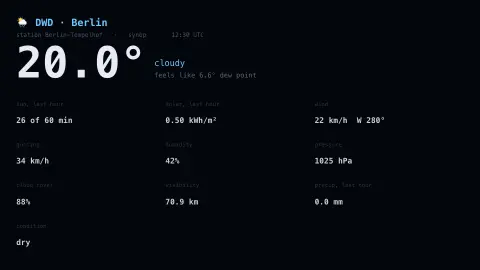
The A German Station, Reporting screensaver shows live observations from a Deutscher Wetterdienst station, served key-less by Bright Sky. Not a forecast — what one instrument measured in the last hour, including the sunshine minutes and solar energy fields most weather APIs throw away. It's free, runs in your browser, and ESC exits.
Live preview
Press ESC to leave fullscreen. Settings are saved in your browser only.
How the A German Station, Reporting screensaver works
The saver reads the source described above and draws it on a canvas — no account, no tracking.
Live observations from a Deutscher Wetterdienst station, served key-less by Bright Sky. Not a forecast — what one instrument measured in the last hour, including the sunshine minutes and solar energy fields most weather APIs throw away.
It refreshes on a schedule, so what you see stays current.
Colours and any options can be changed in settings; nothing is stored beyond your own browser.
Where Bright Sky's readings come from
Deutscher Wetterdienst, the DWD, is Germany's national weather service, and it publishes observations and forecasts through its Open Data programme. Bright Sky is an open-source project that makes popular parts of that data, notably observations from the DWD station network and MOSMIX forecasts, available through a free, simple JSON API, which is why this saver can read a real station directly.
The display is about what an instrument measured, not what a model expects. Beyond temperature, wind and pressure, Bright Sky exposes sunshine as minutes of sunshine over the previous 30 or 60 minutes, so a value of 60 means a fully sunny hour, along with solar radiation fields. The WMO's definition of sunshine counts time when direct solar irradiance is at or above 120 watts per square metre. Those are fields most consumer weather apps discard.
A station is a point, not a region: a reading from a hilltop or an airfield may differ markedly from a street a few kilometres away, and not all stations measure every quantity. When a station lacks a field, Bright Sky can fill it from a nearby station, so a value may not come from the closest instrument.
A worked example
Live observations from a Deutscher Wetterdienst station, served key-less by Bright Sky. Not a forecast — what one instrument measured in the last hour, including the sunshine minutes and solar energy fields most weather APIs throw away.
Settings & tips
- Station changes what the saver shows.
- Accent and Background recolour the display.
- Every value on screen comes from the live source — nothing is simulated.
- Press ESC to leave fullscreen.
Frequently asked questions
- Is this real data?
- Yes — it comes from the source named on this page and is refreshed on a schedule.
- Is a key needed?
- No. This source is fully key-less.
- Is it free?
- Yes, and it runs entirely in your browser.
- What is sunshine duration?
- The time in which direct sunlight exceeded a standard intensity threshold, which the WMO sets at 120 watts per square metre. Over a 60-minute window, 60 means a fully sunny hour, while clouds or darkness reduce it.
- Is this a forecast?
- No. It is the latest reading from a single station, an observation of what has already happened.
- Why might a value be missing?
- Stations do not all carry the same sensors, and equipment can be offline. A blank field means no value was reported for that quantity, not that it is zero.