Maurer Rose Screensaver
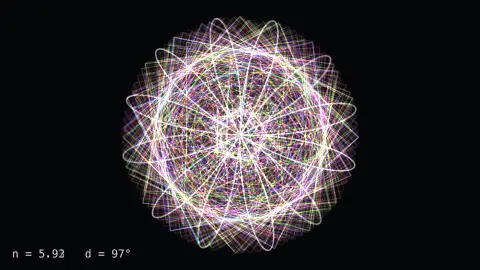
Maurer Rose is a free, in-browser line-art screensaver built on Peter Maurer’s 1987 construction: take the rose curve r = sin(nθ), visit it every d degrees of θ for a full 360 steps, and join the visits in order with straight lines. The 360 chords weave a figure the rose itself never shows. Here n glides continuously and d steps through new values, so the weave keeps re-tying itself. Nothing to download, and ESC exits at any time.
Live preview
Press ESC to leave fullscreen. Settings are saved in your browser only.
How the Maurer Rose screensaver works
A rose curve is r = sin(nθ) in polar coordinates: n petals when n is odd, 2n when it is even. On its own it is drawn faintly in the background so you can see what is being sampled.
The Maurer rose samples that curve at θ = 0°, d°, 2d°, … up to 360·d°, giving 361 points, and connects consecutive points with straight segments. Because d is usually much larger than one degree, each segment leaps across the rose rather than following it, and the leaps overlap into a woven polygon.
The character of the weave depends on the arithmetic of d: values that share no factors with 360 spread the samples evenly and give dense lace, while values close to a divisor of 360 give sparse polygons. The saver walks d through a list of primes, which are the richest, and slides n smoothly between 2 and 6.5.
Segments are drawn additively with a hue that advances along the chord index, and the previous frame fades slightly, so the figure leaves a soft trail as it morphs.
Peter Maurer's rose and the arithmetic of angles
Rose curves were studied by the Italian mathematician Guido Grandi, who worked on them between 1723 and 1728 and gave them the name rhodonea. In polar coordinates r = sin(nθ), the curve has n petals when n is odd and 2n when n is even. Peter Maurer introduced his variation in a 1987 article, A Rose is a Rose..., in The American Mathematical Monthly.
Maurer's construction marks 361 points on the rose at angles 0, d, 2d, up to 360d degrees and joins them in order with 360 straight segments. Because the last angle is a whole number of turns, the route starts and ends at the origin and the figure closes. The result changes dramatically with d, and the angles repeat modulo 360 degrees, so the greatest common divisor of d and 360 controls how many distinct directions are visited before the pattern starts over.
The picture is a reminder that attractive geometry often comes from simple number theory. The figure is not a curve in the strict sense but a polygon, and small changes to d or n can swing it between sparse and busy shapes.
A worked example
At the defaults — animation on, starting from n = 4, d = 97°, Spectrum palette — a dense eight-petalled rosette of chords glows in the centre while the pale eight-petal rose sits beneath it. Over the next few seconds n slides upward and the petals multiply and thin; every nine seconds d jumps to the next prime and the whole lattice re-ties itself into a different weave.
Settings & tips
- Turn animation off and set n = 2, d = 29 or n = 6, d = 71 for two of Maurer’s classic figures.
- Mono in white on black gives clean string-art prints.
- Half-integer n values give roses that take two turns to close, doubling the weave.
Frequently asked questions
- Who was Peter Maurer?
- A mathematician who described this construction in a 1987 paper, “A Rose is a Rose…”, in the American Mathematical Monthly. The figures became a staple of recreational mathematics and generative art.
- Why do some values of d look so much better than others?
- Because the samples are spaced by d degrees around a 360-degree curve, values of d that share factors with 360 revisit the same points and give a sparse polygon, while values coprime to 360 — especially primes — spread the 361 samples evenly and produce dense lace.
- Will this slow my computer down?
- It is tuned to run smoothly on an ordinary laptop. If it feels heavy, raise the Pixel size or lower the speed in the settings; every control takes effect immediately.
- Is the Maurer Rose screensaver free?
- Yes. It runs free in your browser with nothing to download or install, and it keeps working offline once the page has loaded.
- How do I exit the Maurer Rose screensaver?
- Press the ESC key at any time to leave fullscreen and return to the page.
- Is a Maurer rose a true curve?
- No. It is a closed polygon whose vertices lie on a rose curve, joined by straight lines.
- How many petals does a rose curve have?
- For r = sin(nθ) with integer n, an odd n gives n petals and an even n gives 2n petals.
- Who studied rose curves first?
- Guido Grandi named them rhodonea and studied them between 1723 and 1728.