Spirograph Drawing Screensaver
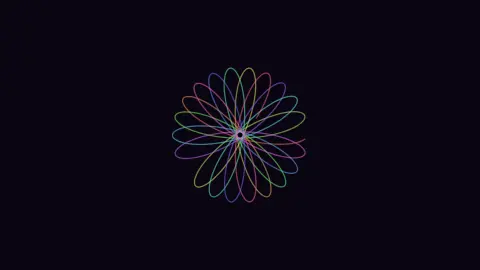
The Spirograph Drawing screensaver traces the classic gear-driven spirograph pattern continuously, with looping curves in shifting color. It is free, runs in your browser, and ESC exits.
Live preview
Press ESC to leave fullscreen. Settings are saved in your browser only.
How the Spirograph Drawing screensaver works
The saver computes the real hypotrochoid/epitrochoid curve math behind the classic spirograph toy.
A small circle rolls around a larger one, tracing a looping pattern as it goes.
The gear ratio slowly drifts over time so the pattern never repeats identically.
Colors shift gradually along the curve for a flowing, hypnotic effect.
The mathematics under the Spirograph toy
The Spirograph drawing toy was developed by the British engineer Denys Fisher and showed the toy at the 1965 Nuremberg International Toy Fair, where it went on sale that year. It consists of toothed wheels with holes: you place a pen in one hole of a small wheel and roll the wheel around the inside of a larger ring. The curve traced is called a hypotrochoid, and if the wheel rolls around the outside it is an epitrochoid.
The shape is set by three numbers: the radius of the fixed circle, the radius of the rolling circle, and how far the pen sits from the rolling wheel’s centre. If the ratio of the two radii is a fraction, such as 21 over 8 when written in lowest terms, the curve closes after the wheel has gone around the ring a number of times equal to the denominator, and it has as many lobes as the numerator. If the ratio is irrational the curve never closes and slowly fills a ring-shaped band.
These curves are close relatives of the cycloid, the curve traced by a point on a wheel rolling along a line, which mathematicians studied in the seventeenth century. The toy’s contribution was a cheap, geared way to explore all of this by hand.
A worked example
As the rolling circle completes one lap, a fresh looping curve overlays the last, gradually building a dense, symmetric flower-like pattern.
Settings & tips
- Accent sets the base curve hue.
- Based on the real hypotrochoid math behind the classic toy.
- The gear ratio drifts slowly so patterns never repeat exactly.
Frequently asked questions
- Is this based on real math?
- Yes — the real hypotrochoid/epitrochoid equations behind the classic spirograph toy.
- Is a key needed?
- No — it is a pure local animation.
- Is it free?
- Yes — free, no download, in your browser.
- Does the pattern repeat?
- The gear ratio drifts slowly, so exact repeats are rare.
- What is a hypotrochoid?
- It is the curve traced by a point attached to a circle that rolls inside a larger fixed circle. Spirograph designs made with the inner ring are hypotrochoids.
- What decides how many lobes a pattern has?
- It is the ratio of the two gear sizes. Written as a fraction in lowest terms, the numerator gives the number of lobes and the denominator gives how many times the wheel travels round before the curve closes.
- Why do some patterns never close?
- If the ratio of the radii is irrational, the wheel never returns to exactly its starting alignment, so the line keeps shifting and gradually fills a band.