Lenia Screensaver
Lenia is a free, in-browser continuous cellular automaton, Bert Chan’s 2018 generalisation of Conway’s Game of Life. Instead of live-or-dead cells and a count of neighbours, every cell holds a value between 0 and 1, reads a smooth ring-shaped average of its surroundings, and grows or shrinks by a bell curve of that average. The result is soft creatures that breathe, split, pulse and crawl. Nothing to download, and ESC exits at any time.
Live preview
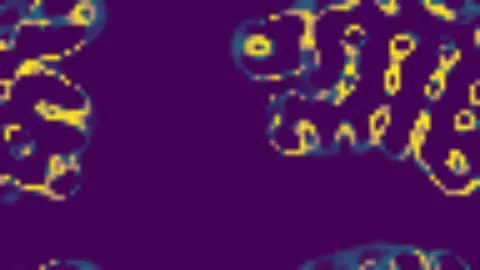
Press ESC to leave fullscreen. Settings are saved in your browser only.
How the Lenia screensaver works
In Conway’s Life a cell counts its eight neighbours and lives with two or three. Lenia replaces every discrete part of that with a smooth one. The neighbourhood is a ring-shaped kernel of radius 9 cells whose weights peak halfway out and fall to zero at both the centre and the rim, normalised to sum to one.
Each cell computes the weighted average U of the values under that kernel and applies a growth function: a bell curve centred on U = 0.15 with a chosen width σ, scaled to run from −1 to +1. The cell’s value moves a small step (dt = 0.1) in the direction the growth function says, and is clamped to 0…1.
Because everything is smooth, patterns are not pixel-locked: they can drift at any angle and speed, rotate, and deform. Random blobs of the right size settle into self-organising colonies — solitons that hold their shape, pulsating rings, cells that bud off daughters.
A colony that starves to nothing or floods the whole grid is reseeded automatically. Growth width σ changes the temperament: narrow is fragile and sparse, wide is dense and blobby.
Smooth artificial life
Lenia belongs to a long line of experiments asking whether lifelike behaviour can arise from simple local rules. John Conway’s Game of Life showed that a grid of on-off cells could produce gliders and machines. Stephan Rafler’s SmoothLife, posted to arXiv in 2011, made space and state continuous, and Bert Wang-Chak Chan’s Lenia, first described in a December 2018 paper (later published in Complex Systems), developed a continuous cellular automaton with many adjustable parameters.
Because everything is continuous, patterns can drift, rotate, split and bounce across the grid in ways that suggest tiny organisms. Chan’s paper reports more than 400 species in 18 families, each tied to particular kernel and growth-function settings, and many were found through interactive evolutionary computation. Some are stable gliders, others wobble, and many dissolve if the settings are slightly off.
These are patterns in a numerical field and not living things. Nothing here eats, reproduces on its own or evolves in the biological sense, although researchers use Lenia to discuss self-organisation and artificial life, and because tiny parameter changes decide whether a creature thrives or vanishes, exploring settings can feel like discovery.
A worked example
At the defaults — Grid width 96, σ 0.014, 2 steps per frame, Viridis palette — half a dozen seeded blobs thin into rings and crescents, some collapsing, some stabilising into yellow-cored cells that drift across the field and occasionally split. Nudge σ up to 0.02 and the colonies become fatter and more robust; down to 0.012 and they become fragile lacework that often dies and reseeds.
Settings & tips
- Grid width 128 or more at 1 step per frame gives finer, slower creatures.
- The Ember palette makes the colonies look like something under a microscope.
- If everything keeps dying, widen σ a little; if it floods, narrow it.
Frequently asked questions
- Who invented Lenia?
- Bert Wang-Chak Chan published Lenia in 2018 as a continuous generalisation of the Game of Life, and has since catalogued hundreds of self-organising “species” in it, including the Orbium glider family. This saver runs his core rule with a single ring kernel.
- How is this different from Conway’s Life?
- Life uses binary cells, integer neighbour counts and a hard rule table; Lenia uses real-valued cells, a smooth kernel and a smooth growth curve, with a small time step. That is what lets its patterns move in any direction and deform instead of stepping cell by cell.
- Will this slow my computer down?
- It is tuned to run smoothly on an ordinary laptop. If it feels heavy, raise the Pixel size or lower the speed in the settings; every control takes effect immediately.
- Is the Lenia screensaver free?
- Yes. It runs free in your browser with nothing to download or install, and it keeps working offline once the page has loaded.
- How do I exit the Lenia screensaver?
- Press the ESC key at any time to leave fullscreen and return to the page.
- What is SmoothLife?
- SmoothLife, by Stephan Rafler (2011), is an earlier continuous version of Conway’s Life. Both it and Lenia replace discrete cells and neighbour counts with smooth values and weighted neighbourhoods.
- Are the creatures in Lenia alive?
- Not in a biological sense. They are self-sustaining patterns in a grid of numbers, similar to a glider in Conway’s Life, but without metabolism or inheritance.
- Why do small settings changes kill the patterns?
- A pattern survives only when its kernel and growth function balance its own spreading and shrinking. A small mismatch lets it either fade out or swell into noise.