Ising Magnet Screensaver
Ising Magnet is a free, in-browser simulation of the two-dimensional Ising model, the simplest physical model of a magnet: a lattice of spins that each want to match their neighbours, fighting thermal noise. The temperature sweeps back and forth through the critical point, so domains coarsen, turn fractal at the transition, dissolve into noise, and re-form. Nothing to download, and ESC exits at any time.
Live preview
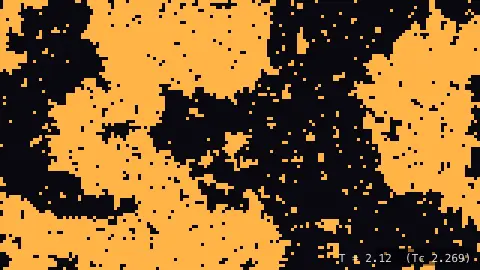
Press ESC to leave fullscreen. Settings are saved in your browser only.
How the Ising Magnet screensaver works
Every cell is a spin, up or down. A spin lowers the energy by agreeing with its four neighbours and raises it by disagreeing. At zero temperature every spin would align; at high temperature thermal kicks flip spins regardless. The interesting physics is in between.
The saver uses the Metropolis algorithm: pick a spin, compute the energy change of flipping it, and flip if the energy goes down — or, if it goes up, with probability exp(−ΔE/T). Cells are updated in a checkerboard order so that neighbours never update in the same pass.
In two dimensions this model has an exact critical temperature, Tc ≈ 2.269 in the model’s units, found by Lars Onsager in 1944. Below it the lattice magnetises into large domains; above it the spins are disordered; right at it the domains come in every size at once and look the same at every magnification.
The default mode sweeps T through Tc every minute or so, and the on-screen readout shows where it is. The other modes hold it cold, hot, or pinned just above critical.
Lenz, Ising and the exact solution by Onsager
The model is named for Ernst Ising and Wilhelm Lenz. Lenz proposed it in 1920 and gave it as a problem to his student Ising, who solved the one-dimensional case in his 1924 doctoral thesis. In one dimension he found no phase transition, and he wrongly concluded that the model would show none in any dimension. In 1944 Lars Onsager solved the two-dimensional square lattice exactly and showed that a phase transition does occur, a landmark in statistical mechanics.
What makes the model so influential is the idea of universality: near a critical point, very different systems can share the same large-scale behaviour, so a lattice of up and down spins can stand in for much more than a magnet. Patterns of domains, fluctuations on all length scales and a slowing of the dynamics are the signs to look for near the transition, and they are what the saver shows as the temperature sweeps through it.
The Metropolis algorithm was introduced in a 1953 paper, Equation of State Calculations by Fast Computing Machines, by Nicholas Metropolis, Arianna and Marshall Rosenbluth, and Augusta and Edward Teller, and it remains a standard Monte Carlo method in physics. Because it samples configurations at a given temperature, the picture is one sample of a statistical ensemble, not a prediction of a particular real magnet.
A worked example
At the defaults — Sweep mode, Spin size 3 — the screen starts as static, and as the readout drops toward 2.27 orange and purple islands grow, merge and fringe into fractal coastlines; below 2 they coarsen into a few huge continents, then dissolve again as T climbs back. Switch to Hold just above critical and the fractal coastline stays on screen indefinitely.
Settings & tips
- Hold just above critical is the most beautiful setting and the one physicists study.
- Cold mode from a random start shows coarsening: domains grow with the square root of time.
- Spin size 1 at fullscreen simulates half a million spins.
Frequently asked questions
- What is the Ising model?
- A model of a magnet as a grid of spins that interact only with their neighbours, proposed by Wilhelm Lenz and solved in one dimension by his student Ernst Ising in 1924. In two dimensions it shows a genuine phase transition and became the template for the theory of critical phenomena.
- What happens at the critical temperature?
- The correlation length diverges: fluctuations occur at every scale from a single spin to the whole lattice, so the pattern is fractal and self-similar. That is why the picture at Tc has islands within islands within islands.
- Will this slow my computer down?
- It is tuned to run smoothly on an ordinary laptop. If it feels heavy, raise the Pixel size or lower the speed in the settings; every control takes effect immediately.
- Is the Ising Magnet screensaver free?
- Yes. It runs free in your browser with nothing to download or install, and it keeps working offline once the page has loaded.
- How do I exit the Ising Magnet screensaver?
- Press the ESC key at any time to leave fullscreen and return to the page.
- What is universality?
- The observation that very different systems can share the same critical behaviour near a phase transition, which is why a simple spin lattice is useful far beyond magnets.
- Why is the one-dimensional model uninteresting?
- Ising solved it in 1924 and found no phase transition: correlations die away exponentially with distance, so the system stays disordered.
- What is Monte Carlo simulation?
- A way to study a system by random sampling. Metropolis-style methods use it to generate typical spin configurations at a chosen temperature.