US Job Openings (JOLTS) Screensaver
The US Job Openings screensaver charts the real monthly JOLTS job-openings series from the Bureau of Labor Statistics, fetched via FRED, as an area chart headlined in millions of open roles. It's free, needs an internet connection, and ESC exits.
Live preview
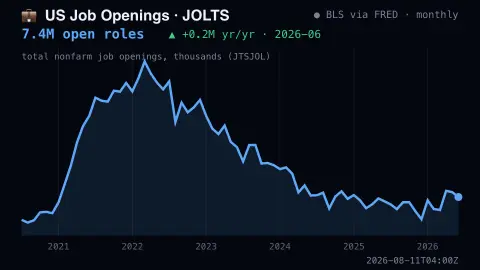
Press ESC to leave fullscreen. Settings are saved in your browser only.
How the US Job Openings (JOLTS) screensaver works
A pipeline script pulls the BLS JOLTS total job-openings series (JTSJOL) from FRED into content/jolts.json — six years of monthly data, no key needed.
The saver draws it as an area chart in the house style, with a faint gridline at each January.
The headline converts thousands of openings into a plain number — say 7.6M open roles — with the year-over-year change beside it in green or red.
JOLTS is a monthly survey published with about a month's lag, so the chart updates on the BLS release schedule, not in real time.
What the JOLTS openings number measures
JOLTS is the Job Openings and Labor Turnover Survey, run by the US Bureau of Labor Statistics. Each month it collects job openings, hires and separations from a sample of about 21,000 establishments in nonagricultural industries. A position counts as an opening only if it is for a specific job, could start within 30 days, and the employer is actively recruiting from outside the establishment. Openings are counted on the last business day of the month, while hires and separations cover the whole month.
The BLS describes the survey as a demand-side indicator of labour shortages. Because it is a sample survey, estimates carry sampling error, and they are revised: monthly, as late reports arrive and seasonal factors are recalculated, and once a year, when the data are benchmarked to updated employment counts. The series charted here is seasonally adjusted, which evens out predictable calendar patterns.
The definition is narrower than a job board. Internal-only postings and jobs that start more than 30 days out are excluded, so the figure will not match a count of advertised vacancies. Openings are also not hires: hires count all additions to the payroll during the month, including rehires and recalls, and are published as a separate series.
A worked example
Set the window to the full six years and the whole post-2020 labor cycle is on one screen: openings doubling to the 12M peak of early 2022, then the long glide back toward 7–8M. In Multi-view it sits naturally beside Labor Force Participation — demand for workers on one side, supply of them on the other.
Settings & tips
- Years shown — the chart window, from a tight two-year view out to the full six-year series.
Frequently asked questions
- Is this real data?
- Yes. It's the BLS Job Openings and Labor Turnover Survey (JOLTS) series, exactly as published on FRED — real openings, not an estimate the saver invents.
- Does it need an API key?
- No. The pipeline reads FRED's public CSV endpoint, which is key-less, and the saver just reads the resulting JSON feed.
- How current is it?
- JOLTS is monthly and lags by about a month — the headline month is the latest the BLS has published, and the saver refreshes on that real schedule.
- Does it work offline?
- No. It reads a small JSON feed over the internet; offline it shows a short notice instead of stale numbers.
- What counts as a job opening?
- A specific position that exists, could start within 30 days, and is being actively recruited for — the BLS definition, so it's stricter than a count of online job ads.
- How is a job opening different from a job posting?
- A JOLTS opening must meet a fixed definition: a specific position, able to start within 30 days, with the employer actively recruiting from outside the establishment. Internal-only postings and later start dates are excluded. Job-board postings follow no such rule, so the two counts can differ.
- Why do past values change after they are published?
- JOLTS estimates are revised monthly as additional reports arrive and seasonal factors are recalculated, and again each year with the annual benchmark revision. The most recent months are the ones still being filled in.
- Does a falling openings count mean layoffs are rising?
- Not directly. JOLTS publishes layoffs and discharges as a separate series alongside openings, so the two can be compared but one does not stand in for the other.