iNaturalist Live Feed Screensaver
The iNaturalist Live Feed screensaver streams real recent citizen-science observations of plants, fungi, insects and animals from iNaturalist. It is free, runs in your browser, and ESC exits.
Live preview
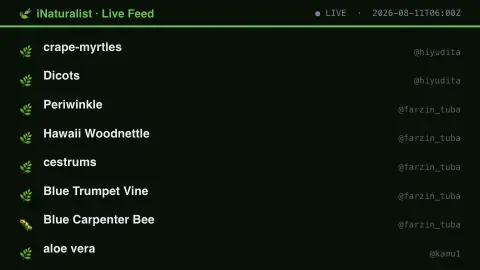
Press ESC to leave fullscreen. Settings are saved in your browser only.
How the iNaturalist Live Feed screensaver works
The saver reads real recent observations from iNaturalist's public API, ordered by observation date.
Each entry shows a real species guess, place and the observer's real username.
The pipeline refreshes the feed regularly as new sightings are logged.
No key is required for this key-less public endpoint.
How iNaturalist turns photos into data
iNaturalist is a citizen-science platform where people upload photos or sounds of living things with a date and location. It merged with the California Academy of Sciences in 2014 and became a joint initiative with the National Geographic Society in 2017; since July 2023 it has been an independent nonprofit. A built-in computer vision tool, first released in 2017 and trained on the platform’s own observations, suggests species from photos, and community members can add identifications to confirm or correct them.
The quality grade shows how far an observation has been checked. A needs-ID observation is verifiable but still waiting for the community to resolve it, a casual one does not meet the requirements to be verifiable, and a research-grade one has a community identification that is well established, generally when more than two-thirds of identifiers agree on a species-level or finer ID. Research-grade observations are often copied into other databases, including the Global Biodiversity Information Facility. The species name on a new observation may be only an early suggestion.
The platform captures what people choose to photograph. Users can obscure a location to show a less precise position or keep it private, and for some threatened taxa the location is obscured automatically, with the public point placed randomly within a cell of roughly 500 km². Treat the feed as a lively sample of nature spotted by volunteers, not a systematic survey.
A worked example
A real observation of a moth logged by a naturalist in a real named location scrolls past exactly as they recorded it.
Settings & tips
- All species, places and usernames shown are real, not simulated.
- Accent recolours the ticker text.
- Covers all taxa — not just birds or mammals.
Frequently asked questions
- Is this real wildlife data?
- Yes — real citizen-science observations from iNaturalist.
- Is a key needed?
- No. iNaturalist's observations API is fully key-less.
- Does it cover only animals?
- No — it covers plants, fungi and insects too, any taxon iNaturalist tracks.
- Is it free?
- Yes — free, no download, in your browser.
- What does research grade mean?
- A verifiable observation whose community identification is well established, generally when more than two-thirds of identifiers agree on a species-level or finer ID. Research-grade observations are often copied into databases such as GBIF.
- Why might an identification be wrong?
- New observations often show only the uploader’s first guess or a suggestion from the computer vision tool, and other users may later confirm or correct it.
- Why are some locations imprecise?
- Users can obscure their own location, and iNaturalist automatically obscures it for some threatened taxa, placing the public point randomly within a cell of roughly 500 km².