Radiation Monitor Network Screensaver
The Radiation Monitor Network screensaver shows real background radiation readings from Safecast's crowd-sourced sensor network. It is free, runs in your browser, and ESC exits.
Live preview
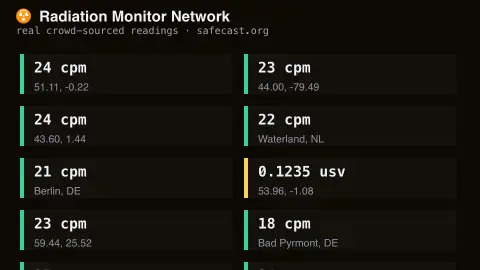
Press ESC to leave fullscreen. Settings are saved in your browser only.
How the Radiation Monitor Network screensaver works
The saver reads real radiation measurements captured today from Safecast's public API.
Each reading shows a real value, unit and, where reported, a real location name.
The pipeline refreshes the board regularly with newly captured readings.
No key is required for this key-less public endpoint.
Safecast and the origins of citizen radiation mapping
Safecast was formed in 2011 in response to the earthquake and tsunami in eastern Japan and the Fukushima Daiichi meltdown, at a time when accurate and trustworthy radiation information was not publicly available. Volunteers collect data, much of it with Safecast-designed hardware, from many parts of the world, and the group releases its data under a CC0 public-domain dedication.
Radiation detectors of the Geiger type tally ionising events. Many report in counts per minute, or cpm, which is how many events the detector counted in sixty seconds. That is not a dose. Converting counts to a dose rate, such as microsieverts per hour, depends on the specific tube inside the instrument, so a number in one unit cannot be turned into another without knowing the detector. Natural background radiation also varies with local geology, altitude and building materials.
Readings are crowd-sourced and unevenly distributed, from different instruments and collection methods, so quality control is not comparable to a regulatory monitoring station. Some points lack a place name and carry only coordinates. Nothing here is an official reading, so the page is a window into a citizen-science network, not a safety monitor.
A worked example
A real reading of 0.08 µSv/h captured by a volunteer sensor appears exactly as reported to Safecast's network.
Settings & tips
- Readings are real crowd-sourced sensor data, not simulated background levels.
- Accent recolours the reading panel.
- Some readings omit a location name if the sensor didn't report one.
Frequently asked questions
- Is this real radiation data?
- Yes — real crowd-sourced sensor readings from the Safecast network.
- Is a key needed?
- No. Safecast's measurements API is fully key-less.
- Should I use this for safety decisions?
- No — it's a display-only screensaver, not a certified monitoring instrument.
- Is it free?
- Yes — free, no download, in your browser.
- What is the difference between cpm and a sievert?
- Counts per minute is how many events a detector registered, while a sievert measures biological dose, and the conversion depends on the detector.
- Why do the readings vary so much?
- Natural background differs from place to place, and different devices and sampling times add further variation.
- Can I reuse the data?
- Safecast says its data is released under CC0, which places it in the public domain, so it can be reused freely.