What Port 6379 Means Screensaver
The What Port 6379 Means screensaver shows iANA's service-name and port-number registry, gathered by the pipeline. Rows covering port ranges rather than single ports, and those marked reserved or unassigned, are dropped — there are thousands and they are scaffolding, not assignments. It's free, runs in your browser, and ESC exits.
Live preview
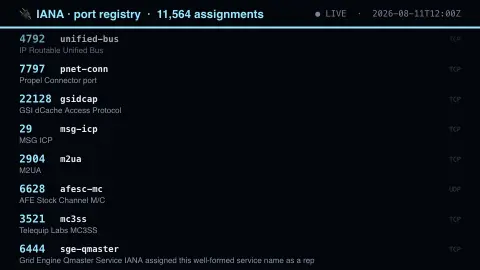
Press ESC to leave fullscreen. Settings are saved in your browser only.
How the What Port 6379 Means screensaver works
The saver reads the source described above and draws it on a canvas — no account, no tracking.
IANA's service-name and port-number registry, gathered by the pipeline. Rows covering port ranges rather than single ports, and those marked reserved or unassigned, are dropped — there are thousands and they are scaffolding, not assignments.
It refreshes on a schedule, so what you see stays current.
Colours and any options can be changed in settings; nothing is stored beyond your own browser.
How a port number is assigned
Every network connection on the internet uses a port, a number from 0 to 65535 that tells a computer which program should receive incoming data. The Internet Assigned Numbers Authority keeps the public registry of which port belongs to which service, so that software from different vendors agrees on, say, 443 for secure web traffic or 6379 for the Redis database.
RFC 6335 divides the range in three. System ports, 0 to 1023, are granted only through IETF Review or IESG Approval. User ports, 1024 to 49151, are usually granted through those routes or otherwise Expert Review, and the request must explain why a dynamic port is unsuitable. Dynamic ports, 49152 to 65535, are never assigned. Service names are 1 to 15 characters of letters, digits and hyphens, and registry requests cover TCP, UDP, SCTP and DCCP.
Registration is a convention, not a rule. Programs can listen on any free port, and a port being assigned to a service says nothing about whether that service is running or safe on your machine.
A worked example
IANA's service-name and port-number registry, gathered by the pipeline. Rows covering port ranges rather than single ports, and those marked reserved or unassigned, are dropped — there are thousands and they are scaffolding, not assignments.
Settings & tips
- Accent and Background recolour the display.
- Every value on screen comes from the live source — nothing is simulated.
- Press ESC to leave fullscreen.
Frequently asked questions
- Is this real data?
- Yes — it comes from the source named on this page and is refreshed on a schedule.
- Is a key needed?
- No. This source is fully key-less.
- Is it free?
- Yes, and it runs entirely in your browser.
- Why are some ports considered well-known?
- Ports 0 to 1023 are the System Ports, also called Well Known Ports, and RFC 6335 allows them to be granted only through IETF Review or IESG Approval, a stricter route than for other ranges.
- Is every program required to use its registered port?
- No. The registry records conventions, and software can be configured to use any available port.
- What does the proto field mean?
- The transport protocol the assignment applies to, such as TCP, UDP, SCTP or DCCP. A port granted for one protocol is marked Reserved for the others until a request converts it.