Human Development Index Board Screensaver
The Human Development Index Board screensaver ranks countries by the real UN Human Development Index, combining life expectancy, education and income, from the United Nations Development Programme. It is free, runs in your browser, and ESC exits.
Live preview
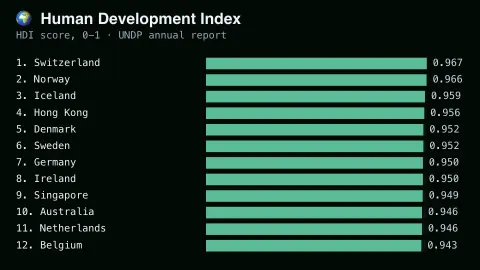
Press ESC to leave fullscreen. Settings are saved in your browser only.
How the Human Development Index Board screensaver works
The saver displays the real annual Human Development Index rankings, published by the United Nations Development Programme.
Countries are ranked by their real reported HDI score, combining health, education and income data.
The board updates once each real year when the new index is published.
No live feed is required — the index is a real, curated annual record.
How the Human Development Index is built
The Human Development Index comes from the Human Development Report Office of the United Nations Development Programme. The first Human Development Report appeared in 1990, shaped by economist Mahbub ul Haq with Amartya Sen’s ideas, as a way to judge countries by what people can do and be, not by income alone. Scores run from 0 to 1.
The index combines three dimensions. Health is life expectancy at birth. Education is mean years of schooling for adults aged 25 and over together with expected years of schooling for children of school-entering age. Standard of living is gross national income per capita, taken as a logarithm because income matters less as it rises. Each dimension is turned into a normalised index, and the HDI is the geometric mean of the three, so a weak result in one dimension cannot be fully offset by a strong one in another.
UNDP advises against comparing HDI values or ranks taken from different report editions, because data are revised and methods change; its consistent time series is the right tool for trends. A country can only be scored when the underlying statistics exist, and UNDP publishes companion measures for inequality and gender, which the HDI itself does not capture.
A worked example
A country's real HDI score reflects real gains in life expectancy or education, exactly as published in the UNDP's own annual report.
Settings & tips
- Accent recolours the ranking bars.
- The index combines three real dimensions: health, education and income.
- The index updates once a real year.
Frequently asked questions
- Is this a real published index?
- Yes — the real annual Human Development Index from the UNDP.
- Is a key needed?
- No — the index is a curated real annual record.
- What does HDI measure?
- A real composite of life expectancy, education and gross national income per capita.
- Is it free?
- Yes — free, no download, in your browser.
- Why does the HDI use a geometric mean?
- A geometric mean penalises imbalance. A low value in one dimension, such as education, cannot be fully made up for by a high value in another.
- Can I compare a country’s rank across years?
- Not by taking ranks from different report editions. UNDP says data revisions and methodology changes make them incomparable, and recommends the consistent trend series in the latest report.
- What goes into the income part of the index?
- Gross national income per capita, entered as a logarithm so that an extra dollar counts for less in a rich country than in a poor one.