Unicorn Startup Board Screensaver
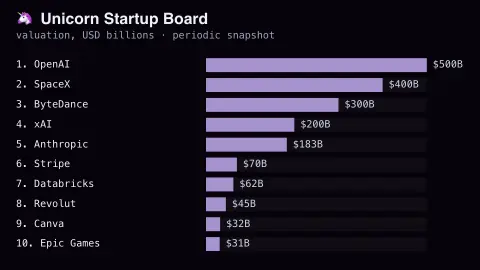
The Unicorn Startup Board screensaver ranks the world's most valuable private startups by their real published valuations. It is free, runs in your browser, and ESC exits.
Live preview
Press ESC to leave fullscreen. Settings are saved in your browser only.
How the Unicorn Startup Board screensaver works
The saver displays a real, curated ranking of the world's most valuable private startups, from published venture-capital research.
Each company shows its real reported valuation, in U.S. dollars.
The board refreshes periodically as new real valuation rounds are published.
No live feed is required — figures are a real, curated periodic snapshot.
What a unicorn valuation really says
The term unicorn was popularised by investor Aileen Lee, who used it in a TechCrunch article published on 2 November 2013. She defined it there as a US-based software company started since 2003 and valued at over $1 billion by public or private market investors, and her original list held 39 companies. The label has since widened to cover private startups of any country and sector valued at a billion dollars or more.
A private valuation is not a market price. It is usually derived from the price per share in the most recent funding round and the number of shares, and the terms of that round matter, because preferred shares often carry protections that ordinary employee shares do not. A headline valuation can therefore overstate what common stock would fetch in a sale. Figures also freeze at the last round, which could be years old.
Different trackers can report different numbers for the same company because they date rounds differently or treat secondary sales and tender offers in their own ways. Down rounds, in which a company raises at a lower valuation, may be reflected late. Treat the board as a snapshot of reported valuations, not an assessment of any company’s financial health or an indication of what its shares are worth.
A worked example
A company's real valuation jumps after a new real funding round is reported, reflected in the board at the next periodic refresh.
Settings & tips
- Accent recolours the ranking bars.
- Valuations are real, based on published private funding rounds.
- Private valuations can shift quickly between real reported rounds.
Frequently asked questions
- Is this real valuation data?
- Yes — real, published venture-capital valuation research.
- Is a key needed?
- No — figures are a curated real periodic snapshot.
- Why do private valuations vary by source?
- Real private valuations are estimated from funding rounds, not public trading, so estimates can vary slightly.
- Is it free?
- Yes — free, no download, in your browser.
- Where does the word unicorn come from?
- Investor Aileen Lee used it in a November 2013 TechCrunch article, applying it to US software startups founded since 2003 and valued at over $1 billion.
- Is a valuation the same as revenue or profit?
- No. It is an estimate of company worth derived from investor pricing, and a company can have a huge valuation while still losing money.
- Can a company’s valuation go down?
- Yes. A later round at a lower price, called a down round, or a write-down by investors can reduce it, although such changes may be reported with delay.