Currency Strength Meter Screensaver
The Currency Strength Meter screensaver ranks major world currencies by their real relative recent strength. It is free, runs in your browser, and ESC exits.
Live preview
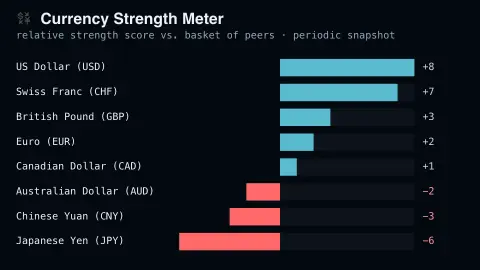
Press ESC to leave fullscreen. Settings are saved in your browser only.
How the Currency Strength Meter screensaver works
The saver displays a real, curated ranking of major currencies by their published recent relative performance against a basket of peers.
Each currency shows a real relative strength score, refreshed periodically.
The board refreshes periodically as new real exchange-rate data is published.
No live feed is required — figures are a real, curated periodic snapshot.
What a currency strength meter averages
Exchange rates are always quoted in pairs: a price of one currency in terms of another. A currency strength meter tries to turn many pair prices into a single score per currency by measuring how it has moved against a group of others over some period, then ranking the results. The aim is to show whether a move in a pair came from one currency rising or the other falling.
The scores depend on choices that are easy to overlook: which currencies make up the basket, which time window is used, and how the moves are weighted. A currency that has gained against its peers over a week might still be weaker than it was a year ago. The most traded currencies tend to feature in any basket: the Bank for International Settlements' Triennial Survey has found the US dollar on one side of the large majority of foreign exchange trades, followed by the euro, the yen and the pound.
Strength here is purely relative price performance. It does not measure the health of an economy, purchasing power at home or inflation, and it is not a forecast. Nothing on the board should be taken as a signal to buy, sell or hold anything.
A worked example
A currency backed by real rising interest rates often shows a real stronger relative performance against a basket of major peers.
Settings & tips
- Accent recolours the ranking bars.
- Strength is measured relative to a basket of major world currencies.
- Figures are a real periodic snapshot, not tick-by-tick live trading data.
Frequently asked questions
- Is this real exchange-rate data?
- Yes — based on real published recent exchange-rate performance.
- Is a key needed?
- No — figures are a curated real periodic snapshot.
- Is this investment advice?
- No — it is an informational comparison, not investment advice.
- Is it free?
- Yes — free, no download, in your browser.
- Why are currencies ranked relative to others?
- A currency's price only exists in terms of another currency, so any strength score has to be defined against a chosen group of peers.
- Does a strong currency mean a strong economy?
- Not necessarily. A currency's exchange rate is a price against other currencies, and a higher price does not by itself say how an economy is doing.
- Which currencies are traded most?
- In the BIS Triennial Survey the US dollar, euro, yen and pound sterling have ranked as the most traded currencies, which is why they appear in so many currency pairs.