Big Mac Index Board Screensaver
The Big Mac Index Board screensaver ranks countries by the real price of a Big Mac, the well-known Economist purchasing-power comparison. It is free, runs in your browser, and ESC exits.
Live preview
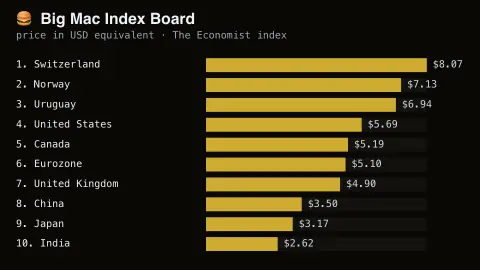
Press ESC to leave fullscreen. Settings are saved in your browser only.
How the Big Mac Index Board screensaver works
The saver displays a real, curated ranking of Big Mac prices by country, converted to a common currency.
Each country shows its real published local price, an informal but widely cited purchasing-power gauge.
The board refreshes periodically as the real Economist index is republished.
No live feed is required — figures are a real, curated periodic snapshot.
The theory behind the Big Mac Index
The Economist introduced the Big Mac Index in September 1986 as a light-hearted way to explain purchasing-power parity, the idea that in the long run exchange rates should move until an identical basket of goods costs the same in any two countries. The Big Mac stands in for that basket because it is a single, recognisable product sold in many countries. The Economist has always presented it as a tool for making exchange-rate theory digestible, not as a precise gauge of currency misalignment.
To use it, you divide the local price of the burger by its price in the United States to get an implied exchange rate, then compare that with the actual rate. If the burger costs less than in America once converted, the currency is deemed undervalued by that margin, and the reverse for a dearer one.
The raw index has a known weakness: burgers tend to be cheaper in poorer countries because local labour costs less. The GDP-adjusted version addresses this by fitting a line between burger prices and GDP per person, then measuring each country's gap from the price that line predicts for its income level. Even so, a burger contains non-traded inputs such as rent and wages, and taxes and pricing strategy differ, so it is an illustration rather than a trading signal.
A worked example
A country with a real notably lower Big Mac price suggests a cheaper real local cost of living relative to a country with a higher price.
Settings & tips
- Accent recolours the ranking bars.
- Based on the real Economist Big Mac Index methodology.
- An informal, widely cited economic comparison, not a precise inflation measure.
Frequently asked questions
- Is this a real published index?
- Yes — the real Big Mac Index, published periodically by The Economist since 1986.
- Is a key needed?
- No — figures are a curated real periodic snapshot.
- Is this a precise economic measure?
- It is intentionally informal — a real, widely cited illustrative comparison, not a precise index.
- Is it free?
- Yes — free, no download, in your browser.
- Why use a burger and not a basket of goods?
- The Big Mac is a single recognisable product sold in many countries, which makes it a simple stand-in for comparing prices, though it is only one product.
- What does the adjusted index do?
- It fits a line between burger prices and GDP per person and measures each country against the price predicted for its income, so comparisons between rich and poor countries are fairer.
- Is a cheap burger proof that a currency is undervalued?
- No. Local costs, taxes and pricing strategy all affect the price, so the index is a rough illustration, not a precise valuation.