Every Wave Ever Detected Screensaver
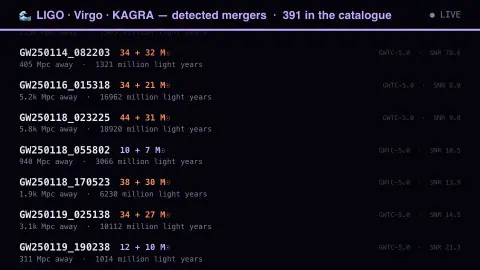
The Every Wave Ever Detected screensaver shows the complete catalogue of gravitational waves ever detected, key-less from GWOSC. Marginal candidates carry a signal-to-noise figure but no masses or distance at all, so they are filtered out rather than drawn as null beside real measurements. It's free, runs in your browser, and ESC exits.
Live preview
Press ESC to leave fullscreen. Settings are saved in your browser only.
How the Every Wave Ever Detected screensaver works
The saver reads the source described above and draws it on a canvas — no account, no tracking.
The complete catalogue of gravitational waves ever detected, key-less from GWOSC. Marginal candidates carry a signal-to-noise figure but no masses or distance at all, so they are filtered out rather than drawn as null beside real measurements.
It refreshes on a schedule, so what you see stays current.
Colours and any options can be changed in settings; nothing is stored beyond your own browser.
How gravitational-wave events are catalogued
GWOSC is the Gravitational Wave Open Science Center, the public access point for data products from the LIGO, Virgo, GEO600 and KAGRA collaborations, which jointly operate it. Its Gravitational-wave Transient Catalog (GWTC) is a cumulative list of confidently detected events, almost all of them pairs of black holes or neutron stars spiralling together and merging. The first, GW150914, was detected in September 2015.
Names encode the detection date: GW, then year, month and day, and newer events add a time of day, as in GW250120_042414. For each event the catalogue tabulates estimated source parameters, which come from fitting waveform models and so carry uncertainty ranges: the masses of the two objects in solar masses, the distance in megaparsecs, and the network signal-to-noise ratio, a measure of how clearly the signal rose above detector noise.
The catalogue is cumulative rather than live. GWOSC says it is only updated periodically and may not contain recently published events, because entries arrive with each catalogue release (GWTC-1, GWTC-2, GWTC-3, GWTC-4.0 and so on). Some entries have blanks for particular parameters, which the saver treats as a reason to show the measured events instead.
A worked example
The complete catalogue of gravitational waves ever detected, key-less from GWOSC. Marginal candidates carry a signal-to-noise figure but no masses or distance at all, so they are filtered out rather than drawn as null beside real measurements.
Settings & tips
- Accent and Background recolour the display.
- Every value on screen comes from the live source — nothing is simulated.
- Press ESC to leave fullscreen.
Frequently asked questions
- Is this real data?
- Yes — it comes from the source named on this page and is refreshed on a schedule.
- Is a key needed?
- No. This source is fully key-less.
- Is it free?
- Yes, and it runs entirely in your browser.
- What do the event names mean?
- The letters GW are followed by the detection date as year, month and day, and newer events add a time of day after an underscore. GW150914 was detected on 14 September 2015.
- What is signal-to-noise ratio?
- It compares the strength of the candidate signal to the background noise in the detectors. Higher values mean a clearer detection and tighter measurements.
- Why do the values have uncertainties?
- Properties like mass and distance are inferred statistically from a noisy waveform, so each is a probable range, with a best estimate in the middle.