Something Just Changed Up There Screensaver
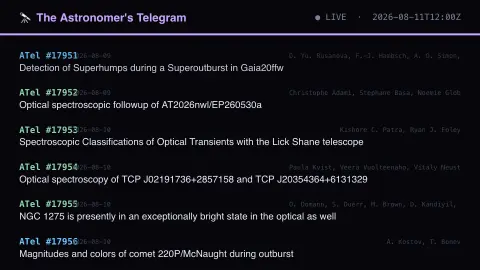
The Something Just Changed Up There screensaver shows the Astronomer's Telegram, gathered key-less by the pipeline. It's free, runs in your browser, and ESC exits.
Live preview
Press ESC to leave fullscreen. Settings are saved in your browser only.
How the Something Just Changed Up There screensaver works
The saver reads the source described above and draws it on a canvas — no account, no tracking.
The Astronomer's Telegram, gathered key-less by the pipeline. This is how observers tell each other within hours that an object needs a telescope tonight — a nova brightening, a source flaring. No peer review; speed is the whole point.
It refreshes on a schedule, so what you see stays current.
Colours and any options can be changed in settings; nothing is stored beyond your own browser.
What an Astronomer's Telegram is
The Astronomer's Telegram, usually shortened to ATel, is a web-based publication for short-notice reports on new astronomical observations: a nova erupting, an X-ray source flaring, a blazar brightening. It was created by Robert Rutledge and launched in December 1997, as described in his 1998 paper in the Publications of the Astronomical Society of the Pacific, so that astronomers could share findings quickly enough for others to follow them up.
Each telegram has a sequential number, a title, authors and a date. Titles tend to name the object and the instrument or band, such as Fermi-LAT, the Large Area Telescope on the Fermi satellite, which observes gamma rays. That tells you which part of the spectrum an observation came from. Posting is limited to professional astronomers and graduate students, and the site is edited by R. E. Rutledge and Derek Fox.
A telegram is a quick preliminary report rather than a finished paper. Positions and brightness values can be revised by later observations, and many events are later written up in full. The running count of telegrams, in the tens of thousands, shows how much of this rapid-reporting traffic has accumulated since the late 1990s.
A worked example
The Astronomer's Telegram, gathered key-less by the pipeline. This is how observers tell each other within hours that an object needs a telescope tonight — a nova brightening, a source flaring. No peer review; speed is the whole point.
Settings & tips
- Accent and Background recolour the display.
- Every value on screen comes from the live source — nothing is simulated.
- Press ESC to leave fullscreen.
Frequently asked questions
- Is this real data?
- Yes — it comes from the source named on this page and is refreshed on a schedule.
- Is a key needed?
- No. This source is fully key-less.
- Is it free?
- Yes, and it runs entirely in your browser.
- Are these results confirmed discoveries?
- No. A telegram is a rapid, preliminary report, often from a single group, and later observations can refine or overturn it.
- Why do telegram numbers keep rising?
- Each new notice receives the next sequential number, so the number reflects how many telegrams have been posted since the service began, with the newest at the top.
- Who runs the Astronomer's Telegram?
- It was started by Robert Rutledge, who is the editor-in-chief, with Derek Fox as editor, according to the site.