Global Event Pulse Screensaver
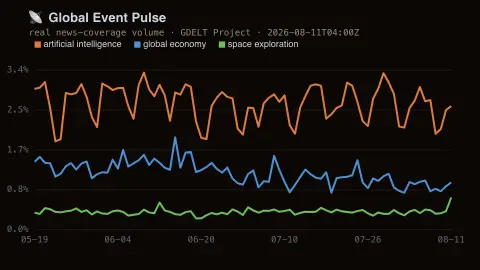
The Global Event Pulse screensaver charts real global news-coverage volume by topic, from the GDELT Project's worldwide monitoring. It is free, runs in your browser, and ESC exits.
Live preview
Press ESC to leave fullscreen. Settings are saved in your browser only.
How the Global Event Pulse screensaver works
The saver reads real daily news-coverage-volume time series per topic from the GDELT Project's API.
Each chart plots a real topic's coverage intensity across recent days.
The pipeline refreshes the series regularly as new coverage is indexed.
No key is required for this key-less public endpoint.
How GDELT turns news into numbers
The GDELT Project, created by Kalev Leetaru, monitors news media in print, broadcast and web form from nearly every country, drawing on hundreds of thousands of sources in more than 100 languages. It processes that coverage to pull out people, organisations, locations, themes and events, at a scale no human team could read.
The charts show coverage volume for a topic over time. GDELT's DOC API reports this timeline as a percentage: matching articles divided by all articles GDELT monitored in that time step (a separate raw-count mode exists). A series can therefore move because a topic was big in the news, or because the overall amount of news changed. The API searches only the most recent three months, and uses daily steps for spans longer than a week. A spike marks a surge in attention and does not tell you whether the news was good or bad.
Because the system is automated, topic matching is approximate. Searches can catch articles that use a word in another sense, and coverage depends on which outlets GDELT monitors. Treat each line as a rough indicator of media attention, not a measurement of what is actually happening.
A worked example
A real spike in coverage volume for a topic like space exploration lines up with real news events GDELT indexed that week.
Settings & tips
- Coverage volume reflects GDELT's real worldwide monitoring of news media, not simulated trends.
- Accent recolours the chart lines.
- Topics cycle through a curated real set like climate, AI and the global economy.
Frequently asked questions
- Is this real news data?
- Yes — real global news-coverage volume from the GDELT Project.
- Is a key needed?
- No. GDELT's DOC API is fully key-less.
- What does 'volume' mean here?
- It's GDELT's real measured share of monitored global news coverage mentioning the topic.
- Is it free?
- Yes — free, no download, in your browser.
- Does a spike mean something important happened?
- It means the topic got more coverage than usual. Importance and attention are not the same thing, and heavy coverage can follow a trivial but widely shared story.
- Why is the value a small decimal rather than a count?
- GDELT's timeline volume divides the number of matching articles by the total number of articles it monitored in each time step, so it is a share rather than a count. That keeps results comparable as the total amount of news changes.
- How many languages does GDELT cover?
- GDELT describes monitoring news in more than 100 languages. Its DOC API machine-translates 65 of them into English for searching, so coverage is not equal everywhere.