Global News Sentiment Tracker Screensaver
The Global News Sentiment Tracker screensaver charts real average news-coverage sentiment (tone) by topic, from the GDELT Project's global media monitoring. It is free, runs in your browser, and ESC exits.
Live preview
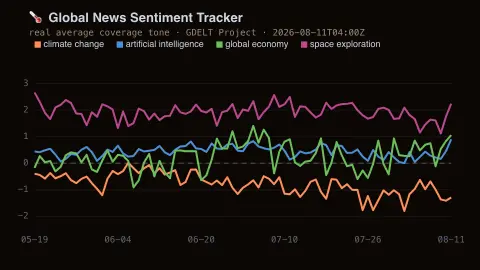
Press ESC to leave fullscreen. Settings are saved in your browser only.
How the Global News Sentiment Tracker screensaver works
The saver reads a real daily average-tone time series per topic from the GDELT Project's API.
Positive values mean more positive real coverage that day; negative values mean more negative real coverage.
The pipeline refreshes the series regularly as new coverage is analyzed.
No key is required for this key-less public endpoint.
What GDELT's tone score measures
The GDELT Project, created by Kalev Leetaru, monitors the world’s news media in print, broadcast and web formats, in many languages, and processes it automatically into records of events, people, organizations, locations, themes and emotions. Its data is built to be queried at scale, and its DOC 2.0 API can return a timeline of the average tone of all coverage matching a query, which is the series this screensaver draws.
Tone is an automated sentiment score for the coverage matching a query. In GDELT’s API documentation the scale runs from -100 (extremely negative) to +100 (extremely positive), but typical values fall between about -20 and +20, and articles near zero read as more neutral or factual. Small differences between days may therefore be mostly noise. Negative values are common in many topics because news coverage tends to focus on problems, conflict and disasters.
It is important to know what the number does not say. A negative tone for a topic does not mean the underlying events got worse; it means the language used was more negative. Automated scoring can miss sarcasm, context and quoted speech, and the mix of outlets monitored can change over time. Treat the line as a rough gauge of how coverage sounds, not a measure of reality or public opinion.
A worked example
A real dip into negative tone for a topic lines up with real coverage of a difficult news day that GDELT's language analysis actually measured.
Settings & tips
- Tone reflects GDELT's real automated sentiment analysis of global news text, not a human editorial rating.
- Accent recolours the chart lines.
- Topics cycle through a curated real set like climate, AI and the global economy.
Frequently asked questions
- Is this real sentiment data?
- Yes — real automated tone analysis from the GDELT Project.
- Is a key needed?
- No. GDELT's DOC API is fully key-less.
- How is tone measured?
- GDELT's real algorithm scores article language on a signed scale from very negative to very positive.
- Is it free?
- Yes — free, no download, in your browser.
- Why is the tone for most topics below zero?
- News tends to emphasise conflict, risk and harm, so the average language is often negative even in ordinary times. A level below zero is typical rather than alarming.
- Does a dip mean something bad happened?
- Not necessarily. It means the coverage used more negative language that day, which can follow a major event but can also result from changes in which articles matched the query.
- Is the tone score the same as public opinion?
- No. It describes the wording of news articles, not what readers or citizens feel, and it covers only the media that GDELT monitors.