News Coverage by Country Screensaver
The News Coverage by Country screensaver ranks countries by their real relative share of global news coverage, from the GDELT Project. It is free, runs in your browser, and ESC exits.
Live preview
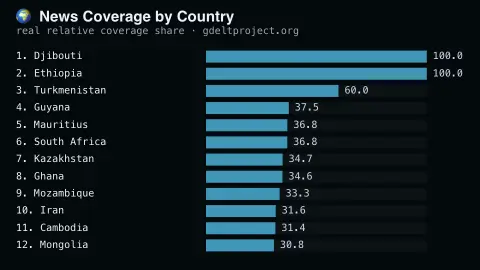
Press ESC to leave fullscreen. Settings are saved in your browser only.
How the News Coverage by Country screensaver works
The saver reads a real per-country coverage-share breakdown from the GDELT Project's API.
Countries are ranked by their real relative share of that day's coverage, highest first.
The pipeline refreshes the board regularly as new coverage is indexed.
No key is required for this key-less public endpoint.
GDELT and the arithmetic of media attention
GDELT, the Global Database of Events, Language and Tone, is an open database built by monitoring the world's news media. It was created by Kalev Leetaru and draws on print, broadcast and online outlets from nearly every country, processing sources in more than a hundred languages. Its data are published openly and updated regularly, and researchers use them to study how attention to events and regions rises and falls.
The ranking on the board is about attention, meaning how much of the coverage mentions a country, not about whether the coverage is positive, negative or accurate. A country can top the list because of a disaster, an election, a sporting event or simply because it is heavily covered by outlets GDELT watches. The scale is relative, so it describes position within the coverage, not an absolute story count.
Because the system is automated, it inherits machine limits. Place-name extraction can confuse similarly named locations, a single story syndicated by many outlets can be counted many times, and translation and source coverage are uneven across languages. Use it as a rough barometer of global media interest, not a verdict on any country.
A worked example
A country whose outlets published a real disproportionate share of coverage on a topic sits at the top of the board, exactly matching GDELT's own measurement.
Settings & tips
- Rankings are real relative shares of coverage, not raw article counts.
- Accent recolours the ranking bars.
- The topic tracked can be reconfigured in the pipeline.
Frequently asked questions
- Is this real media data?
- Yes — real source-country coverage shares from the GDELT Project.
- Is a key needed?
- No. GDELT's DOC API is fully key-less.
- What does the number mean?
- It's GDELT's real relative intensity score (0-100), not a raw article count.
- Is it free?
- Yes — free, no download, in your browser.
- Does a high rank mean a country has bad news?
- Not necessarily. The measure counts how much coverage mentions the country, and attention can come from good news, sport, politics or crisis.
- How many languages does GDELT cover?
- GDELT says it processes sources in more than a hundred languages, though translation quality and source coverage are uneven.
- Who runs GDELT?
- GDELT was created by Kalev Leetaru, and its data are published openly for anyone to study.