UNHCR Refugee Population Board Screensaver
The UNHCR Refugee Population Board screensaver ranks real refugee flows between countries of origin and asylum. It is free, runs in your browser, and ESC exits.
Live preview
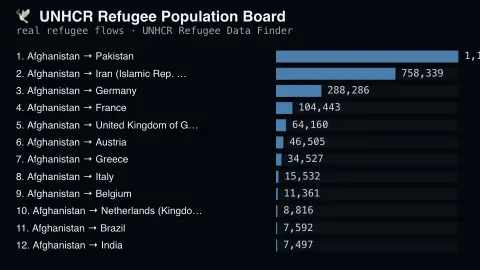
Press ESC to leave fullscreen. Settings are saved in your browser only.
How the UNHCR Refugee Population Board screensaver works
The saver reads real published refugee population statistics from UNHCR's own API.
Flows are ranked by real refugee count, highest first.
The pipeline refreshes the board on UNHCR's own annual reporting schedule.
No key is required for this key-less public endpoint.
Reading UNHCR population statistics
UNHCR, the UN Refugee Agency, publishes its statistics through a public Refugee Statistics API that returns JSON. Queries can be filtered by year, country of origin (coo) and country of asylum (coa), and the data covers refugees, asylum-seekers, internally displaced persons and stateless people, across almost 70 years. This board takes origin and asylum pairs, such as people from Afghanistan living in a given host country, and ranks them by refugee count.
The categories are counted separately. UNHCR defines asylum-seekers as people who have sought international protection and whose claims for refugee status have not yet been determined, so they are not in the refugee figure. Internally displaced persons have not crossed a border. The refugee count is therefore one slice of forced displacement.
UNHCR sources its data primarily from governments and from its own operations, and where registration data is missing it relies on statistical models for estimates. The annual statistics are published each June and describe the situation as of December of the previous year, so they lag: a crisis that began recently will not appear until a later release. The board shows a count at a point in time, not people arriving during the year.
A worked example
A real flow of refugees from one real country of origin to a real country of asylum sits at the top of the board, exactly matching UNHCR's own figures.
Settings & tips
- Figures are real UNHCR-published statistics, not estimates.
- Accent recolours the ranking bars.
- Data reflects UNHCR's real most-recently-published reporting year.
Frequently asked questions
- Is this real refugee data?
- Yes — real published statistics from UNHCR's own Refugee Data Finder.
- Is a key needed?
- No. UNHCR's population API is fully key-less.
- How current is the data?
- It reflects UNHCR's real most-recently-published annual reporting year.
- Is it free?
- Yes — free, no download, in your browser.
- What is the difference between a refugee and an asylum-seeker?
- UNHCR’s statistics define asylum-seekers as people who have sought international protection and whose claims for refugee status have not yet been determined. They are counted separately from refugees.
- Are internally displaced people included?
- UNHCR’s statistics do cover internally displaced persons, but as a separate category. This ranking covers refugees by country of origin and country of asylum only.
- How current are the numbers?
- UNHCR publishes its annual statistics each June, describing the situation as of December of the previous year. The board therefore shows a year-end count and lags behind recent events.