A Distro Updating Itself Screensaver
The A Distro Updating Itself screensaver shows packages moving through Fedora's update system, key-less from Bodhi. Karma is a human vote — someone installed it and reported back — not a test result. It's free, runs in your browser, and ESC exits.
Live preview
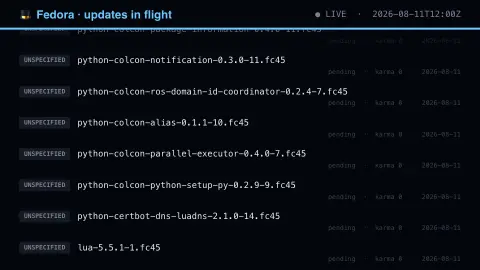
Press ESC to leave fullscreen. Settings are saved in your browser only.
How the A Distro Updating Itself screensaver works
The saver reads the source described above and draws it on a canvas — no account, no tracking.
Packages moving through Fedora's update system, key-less from Bodhi. Karma is a human vote — someone installed it and reported back — not a test result.
It refreshes on a schedule, so what you see stays current.
Colours and any options can be changed in settings; nothing is stored beyond your own browser.
How Fedora updates move through Bodhi
Bodhi is the web application Fedora uses to manage package updates. A maintainer bundles builds into an update and submits it; Bodhi runs sanity checks, such as confirming the build exists in Koji and is tagged as an updates candidate, then queues it to enter the updates-testing repository at the next compose. Once the update is stable it reaches the main updates repository, where ordinary users receive it.
Each update has a type and a status that tracks its position in the pipeline, with values such as pending, testing and stable. Other states include obsolete, when a newer version of the package supersedes the update, and unpushed, when an update is removed from testing. A row therefore shows a moment in a process, not a final outcome.
While an update is in testing, testers leave karma and comments after trying it. Karma is human feedback, not a test result. By default, with autokarma enabled, reaching karma of 3 sends an update to stable and reaching -3 unpushes it. Maintainers can also enable autotime, which pushes an update to stable after a set time in testing, though any negative karma disables it.
A worked example
Packages moving through Fedora's update system, key-less from Bodhi. Karma is a human vote — someone installed it and reported back — not a test result.
Settings & tips
- Accent and Background recolour the display.
- Every value on screen comes from the live source — nothing is simulated.
- Press ESC to leave fullscreen.
Frequently asked questions
- Is this real data?
- Yes — it comes from the source named on this page and is refreshed on a schedule.
- Is a key needed?
- No. This source is fully key-less.
- Is it free?
- Yes, and it runs entirely in your browser.
- What does karma mean on a Fedora update?
- Testers who tried the update in testing give it positive or negative karma, signalling whether it worked. It is human feedback rather than an automated test.
- What does pending mean?
- Bodhi is running sanity checks on the update, which has not yet reached the testing repository, so it has not reached testers.
- Does an update here mean it is on my computer?
- Not yet. It reaches users once it is in the stable updates repository and your package manager picks it up.