Exchange Board Screensaver
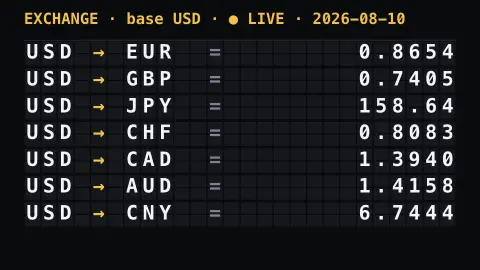
The Exchange Board screensaver is a split-flap currency board that flips through live foreign-exchange rates against your chosen base currency, using European Central Bank reference rates from the key-less Frankfurter API. It's free, runs in your browser, and ESC exits.
Live preview
Press ESC to leave fullscreen. Settings are saved in your browser only.
How the Exchange Board screensaver works
The saver fetches the latest reference exchange rates from the free Frankfurter API, which republishes the European Central Bank's daily rates — no key required.
Each row pairs your base currency with another (USD → EUR, USD → JPY, and so on) and shows the rate as flipping split-flap tiles.
It remembers the previous values, so a green ▲ or red ▼ arrow shows whether each rate rose or fell since the last update.
The board re-fetches periodically and re-flips any tiles whose digits changed.
ECB reference rates and what they are
The European Central Bank publishes euro foreign-exchange reference rates once each working day, except on TARGET closing days. They come from a daily concertation procedure between central banks across Europe, which usually takes place around 14:10 CET, and the rates are typically updated around 16:00 CET. They are quoted as units of a foreign currency per one euro. The ECB says they are for information only and strongly advises against using them for transactions.
Frankfurter is an open-source exchange rates API that needs no key. It began with the ECB as its source and now draws on central banks and official sources, refreshing daily. Its default rates are blended across providers, so the board's figures come from whatever the API serves and may not match the ECB's page exactly. A rate between two non-euro currencies is a derived cross rate rather than one directly published by the ECB.
The ECB quotes 29 currencies against the euro and has suspended its euro/rouble reference rate, last published on 1 March 2022. The ups and downs on the board therefore compare one daily update with the previous one and cannot show intraday swings. Bank and card rates differ from reference rates because they add spreads and fees. A display like this gives a sense of how currencies have moved, not what rate you would actually get.
A worked example
Pick a base of GBP and the board clatters through rows like GBP → EUR 1.1740 ▲ and GBP → JPY 213.6 ▼, the tiles riffling to each new rate as the ECB figures update through the day.
Settings & tips
- Base currency sets which currency every rate is quoted against.
- Flap speed controls how fast the tiles riffle.
- Header color recolours the board title.
Frequently asked questions
- Are the rates real?
- Yes. They're European Central Bank reference rates served by the free Frankfurter API, refreshed while the saver runs.
- How current are they?
- The ECB publishes reference rates once per working day, so the board reflects the latest official daily rates rather than tick-by-tick trading prices.
- Does it need a key?
- No. Frankfurter is free and key-less; the saver only needs an internet connection.
- Is this financial advice?
- No. It's a display of public reference rates for ambiance, not advice, and not live trading prices.
- Is it free?
- Yes — free, no download, in your browser.
- When are the reference rates published?
- Once per working day, typically around 16:00 CET, after a concertation procedure around 14:10 CET. No new ECB rates appear on TARGET closing days.
- Why do exchange offices give a different rate?
- They use live market rates plus a margin or fee. The ECB says its reference rates are for information only and advises against using them for transactions.
- How is a rate between two non-euro currencies calculated?
- It is derived rather than quoted directly, by combining each currency's rate against a common base such as the euro.