What a Euro Buys Screensaver
The What a Euro Buys screensaver shows the ECB's daily reference rates, straight from the Bank's own key-less service. The dataflow still carries the euro's predecessors — the drachma frozen at its 2000 fixing, the Cypriot pound at 2007 — so only rows dated to the newest observation are shown. It's free, runs in your browser, and ESC exits.
Live preview
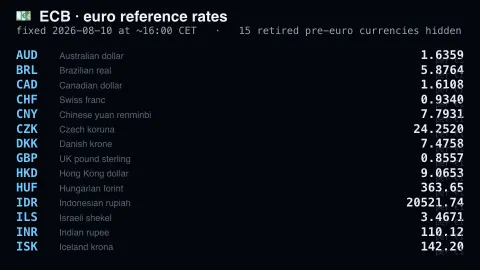
Press ESC to leave fullscreen. Settings are saved in your browser only.
How the What a Euro Buys screensaver works
The saver reads the source described above and draws it on a canvas — no account, no tracking.
The ECB's daily reference rates, straight from the Bank's own key-less service. The dataflow still carries the euro's predecessors — the drachma frozen at its 2000 fixing, the Cypriot pound at 2007 — so only rows dated to the newest observation are shown.
It refreshes on a schedule, so what you see stays current.
Colours and any options can be changed in settings; nothing is stored beyond your own browser.
How the ECB sets its daily reference rates
The European Central Bank publishes euro foreign exchange reference rates on each working day except TARGET closing days, quoted as how many units of another currency one euro buys. They come from a daily concertation procedure among central banks across Europe, which normally takes place around 14:10 CET, and are usually updated at around 16:00 CET.
The ECB says the rates are published for information purposes only and strongly discourages using them for transactions, so what a bank or card company offers you will differ, usually by a margin. Because there is one fixing a day, the series is a sequence of snapshots and says nothing about how a currency moved between them.
The service the saver reads is a general dataflow that still carries rows for retired currencies, such as the Greek drachma and the Cypriot pound. Those rows are permanent historical entries, not current markets, so only rows dated to the newest observation are drawn. The set of currencies is the ECB's own list of reference currencies, and it can change: the ECB suspended its euro-rouble rate after 1 March 2022.
A worked example
The ECB's daily reference rates, straight from the Bank's own key-less service. The dataflow still carries the euro's predecessors — the drachma frozen at its 2000 fixing, the Cypriot pound at 2007 — so only rows dated to the newest observation are shown.
Settings & tips
- Accent and Background recolour the display.
- Every value on screen comes from the live source — nothing is simulated.
- Press ESC to leave fullscreen.
Frequently asked questions
- Is this real data?
- Yes — it comes from the source named on this page and is refreshed on a schedule.
- Is a key needed?
- No. This source is fully key-less.
- Is it free?
- Yes, and it runs entirely in your browser.
- Can I use these rates for a real transaction?
- They are reference rates, not tradable prices. The ECB publishes them for information only and strongly discourages using them for transactions; any provider will quote its own rate.
- Why does a rate not change on some days?
- The rates are published on working days only, excluding TARGET closing days, so on weekends and those holidays the latest value stays in place.