Everything NASA Measures Screensaver
The Everything NASA Measures screensaver shows earth-observation collections from NASA's Common Metadata Repository, key-less. The CMR indexes datasets from far more than NASA: the organisation codes run to Swiss forest inventories, Australian Antarctic surveys and Belgian satellite processing. Start dates reaching into the 1970s are common, because a climate collection is only useful with decades behind it. It's free, runs in your browser, and ESC exits.
Live preview
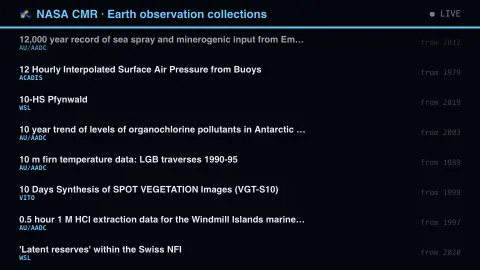
Press ESC to leave fullscreen. Settings are saved in your browser only.
How the Everything NASA Measures screensaver works
The saver reads the source described above and draws it on a canvas — no account, no tracking.
Earth-observation collections from NASA's Common Metadata Repository, key-less. The CMR indexes datasets from far more than NASA: the organisation codes run to Swiss forest inventories, Australian Antarctic surveys and Belgian satellite processing. Start dates reaching into the 1970s are common, because a climate collection is only useful with decades behind it.
It refreshes on a schedule, so what you see stays current.
Colours can be changed in settings; nothing is stored beyond your own browser.
NASA's Common Metadata Repository
NASA's Earth Observing System Data and Information System (EOSDIS) includes a set of archive centres, known as DAACs (Distributed Active Archive Centers), that store and distribute Earth science data. The Common Metadata Repository, or CMR, is described by NASA as the authoritative management system for all EOSDIS metadata: a searchable catalogue of descriptions, not of the data files themselves. It lets a scientist find, for example, a sea-ice product or a soil-moisture collection without knowing which centre holds it.
What appears here is a collection, a group of data files described by a name, a temporal range and a spatial footprint. The CMR also holds metadata for individual granules (single data files), variables, and tools and services. NASA is a member of the Committee on Earth Observation Satellites (CEOS), and the CMR also carries collection records from other CEOS member agencies, which is why you may see surveys or regional studies that have nothing to do with NASA spacecraft.
A listing is an index entry, so it says what exists, not how good, complete or recent the data is. NASA states that its data are openly available, but downloading them generally requires a free Earthdata Login account, and access and licensing terms are set by the data provider.
A worked example
Earth-observation collections from NASA's Common Metadata Repository, key-less. The CMR indexes datasets from far more than NASA: the organisation codes run to Swiss forest inventories, Australian Antarctic surveys and Belgian satellite processing. Start dates reaching into the 1970s are common, because a climate collection is only useful with decades behind it.
Settings & tips
- Accent and Background recolour the display.
- Every value on screen comes from the live source — nothing is simulated.
- Press ESC to leave fullscreen.
Frequently asked questions
- Is this real data?
- Yes — it comes from the source named on this page and is refreshed on a schedule.
- Is a key needed?
- No. This source is fully key-less.
- Is it free?
- Yes, and it runs entirely in your browser.
- What is a DAAC?
- A Distributed Active Archive Center, one of the NASA EOSDIS data archives that store and distribute Earth science datasets for particular scientific areas.
- Why are non-NASA datasets included?
- The repository also holds collection records from other agencies that are members of the Committee on Earth Observation Satellites, so providers can include organisations from many countries.
- Can I download the data from the collection entry?
- The entry describes the data and points to where it lives. Downloads are handled by the data provider and generally need a free NASA Earthdata Login.