What Energy Just Released Screensaver
The What Energy Just Released screensaver shows research records released by the US Department of Energy, key-less from OSTI. The dates run into the future and that is not an error: a journal article carries the date of the issue it will appear in, so work released now can be stamped December, and sorting on it puts forthcoming work first. The product type is drawn because DOE publishes datasets and technical reports alongside papers. It's free, runs in your browser, and ESC exits.
Live preview
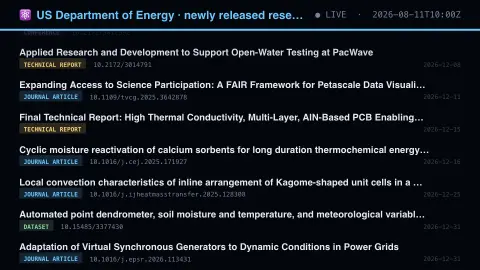
Press ESC to leave fullscreen. Settings are saved in your browser only.
How the What Energy Just Released screensaver works
The saver reads the source described above and draws it on a canvas — no account, no tracking.
Research records released by the US Department of Energy, key-less from OSTI. The dates run into the future and that is not an error: a journal article carries the date of the issue it will appear in, so work released now can be stamped December, and sorting on it puts forthcoming work first. The product type is drawn because DOE publishes datasets and technical reports alongside papers.
It refreshes on a schedule, so what you see stays current.
Colours can be changed in settings; nothing is stored beyond your own browser.
OSTI, the Energy Department's research library
OSTI is the Office of Scientific and Technical Information, a unit of the US Department of Energy’s Office of Science. Its job is to collect, preserve and share scientific and technical information from research the department funds, at national laboratories, universities and other institutions. Its collections include journal articles and accepted manuscripts, technical reports, conference and workshop papers, scientific datasets, software, patents, books and theses.
The display draws on those records, and the product type tells you what sort of document each is. A technical report is usually a formal write-up of a project, often long and detailed. A conference entry is a paper or presentation from a meeting. A dataset is a collection of data rather than an analysis of it. Because the work comes from national laboratory research, titles are often highly technical.
Dates can mislead. Journal articles are stamped with the date of the issue they will appear in, so a record released now can carry a later date, and a list sorted that way may show future dates. OSTI’s journal article records carry DOIs that link to the full text on the publisher’s website, so reading a paper may depend on that publisher’s access terms, and the same work may also be available elsewhere.
A worked example
Research records released by the US Department of Energy, key-less from OSTI. The dates run into the future and that is not an error: a journal article carries the date of the issue it will appear in, so work released now can be stamped December, and sorting on it puts forthcoming work first. The product type is drawn because DOE publishes datasets and technical reports alongside papers.
Settings & tips
- Accent and Background recolour the display.
- Every value on screen comes from the live source — nothing is simulated.
- Press ESC to leave fullscreen.
Frequently asked questions
- Is this real data?
- Yes — it comes from the source named on this page and is refreshed on a schedule.
- Is a key needed?
- No. This source is fully key-less.
- Is it free?
- Yes, and it runs entirely in your browser.
- Are all OSTI documents free to read?
- Many are, particularly technical reports and accepted manuscripts of funded research, but some records link to a publisher’s website, where access may depend on that publisher’s terms.
- What is a national laboratory?
- A research institution funded by the Department of Energy. OSTI collects the scientific and technical information that comes out of DOE-funded work at these laboratories and other institutions.
- What kinds of documents does OSTI hold?
- Journal articles and accepted manuscripts, technical reports, conference and workshop papers, datasets, software, patents, books and theses.